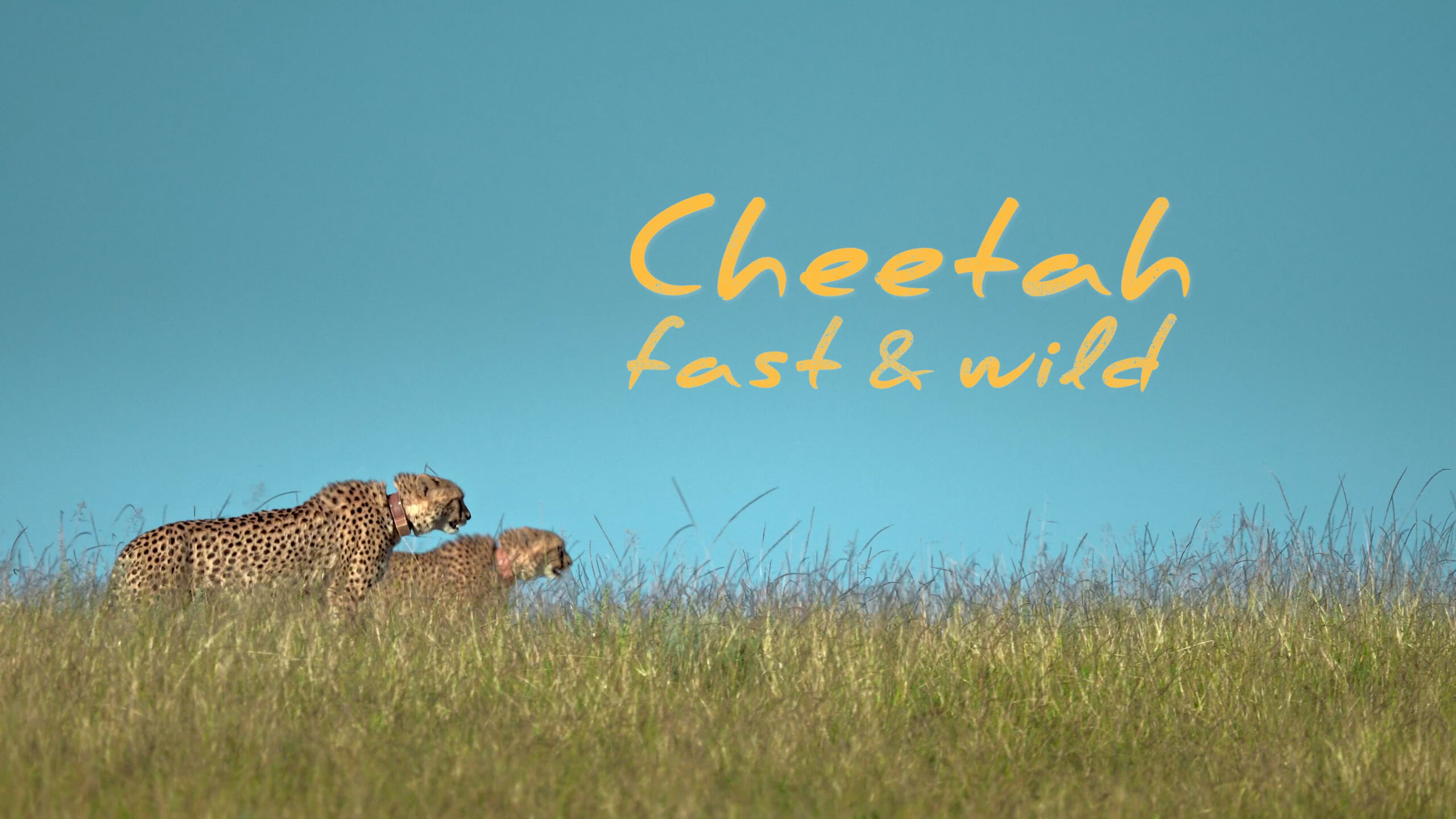
Cheetah Fast & Wild is a rare and intimate look at survival, which follows both captive-reared and wild-born cheetah cubs as they navigate the unforgiving realities of life in the wild. What unfolds is not just a nature story, but a layered exploration of storytelling, ethics, and conservation. Fast-paced and challenging, editing Cheetah Fast and Wild is an obstacle course given the volume of footage to work with. Armin KS chats with Kelly Morris to get his take on the takes here.
With so much observational footage, how did you find the emotional core of the story? How did you balance the dual narratives of captive and wild cheetahs to maintain tension and cohesion?
So this was actually a big challenge. When I first came onto the show, I was looking at a lot of footage, a lot of cheetahs, and a lot of different locations. And for me, coming in as a new viewer, the first thing I thought was, how am I supposed to tell these cheetahs apart? I always approach a project cold, like I’m someone sitting in their living room or in a theatre watching this who knows nothing about the subject. Maybe they don’t even know anything about cheetahs. That’s my starting point.
Because often the director has been immersed in this world for years. They know everything about subject or animal, and it’s easy to fast-forward through ideas or assume the audience understands things. But my first reaction was just being honest. I was like, these cats all look the same. I hate to say it, but that was my initial response. It’s a lot of big, beautiful cats, and at first glance they felt very similar. I didn’t yet know enough about cheetahs to tell them apart. I’d cut a piece about wolves before, and they look quite different from one another, like dogs do, but here I wasn’t seeing that right away.
The first thing I had to do was organize the material in a way that was manageable. I broke everything down by location, and then by shoot date within each location. We had returned to certain places multiple times, so that structure was essential just to make sense of it. I created a mirrored system so Joe and I could both work on the edit simultaneously at our respective studios.
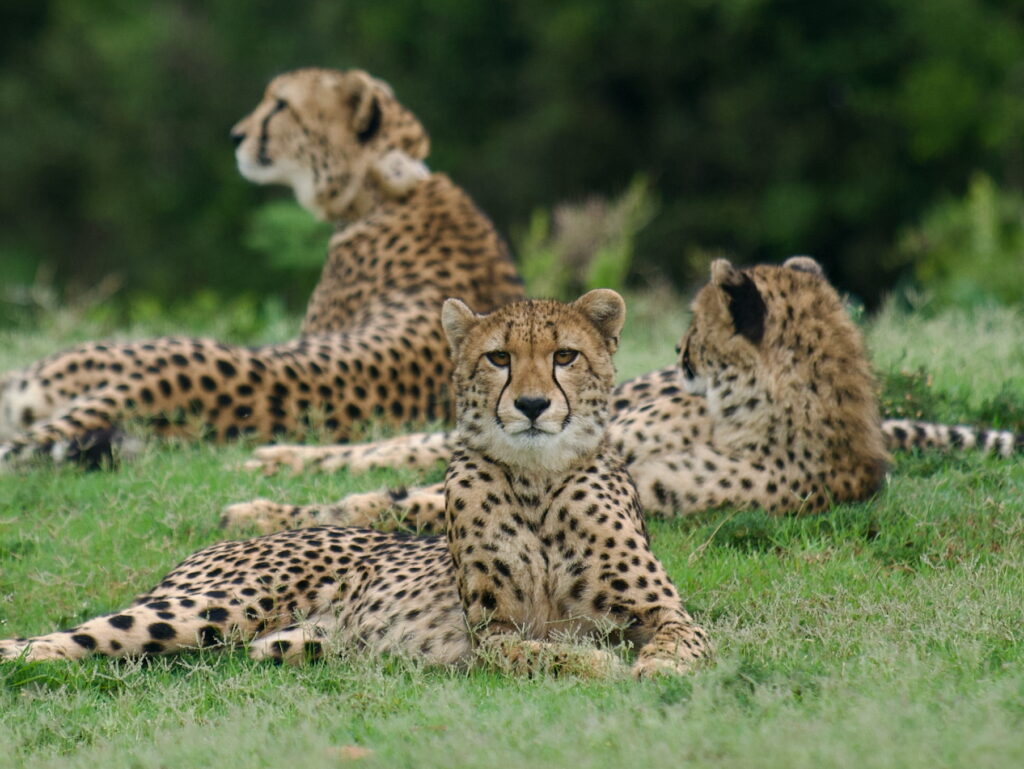
From there, we started identifying who the actual characters were. Joe had already begun shaping that when I came on, but we came to agree on who to follow. There was the desert location, Sanbona, with Cheetah 82, a wild mother raising three cubs. She was raising her second litter, a successful, experienced mother and hunter. Then there were Lily and Iris at Ashia Cheetah Center, two orphaned female cheetahs, being trained by humans for release. They have access to specialized running yard, are fed wild game, with limited human contact, all in preparation for being released into a wilding reserve.
There were also sub-characters, like Khatu, the forest hunter, with her cubs, as well as Cheetah 83, one of 82’s offspring and a master hunter, plus various cheetahs at multiple wildlife reserves. As we were editing and trying to cut it to time, I was a bit skeptical about carrying a third and fourth storyline, but Joe was keen to work these extra characters in, and rightly so, so we found a way to do it.
Once we landed on who the characters were, that’s where the emotional core really started to emerge. Because the key was to stop seeing them as “cheetahs” and start seeing them as individuals. We needed to fall in love with them, get to know them, get close to them. That meant leaning into extreme close-ups, so close you could feel like you could touch them, see the mist of their breathing, their behaviour, little quirks, how they move, how they blink, how they react. They’re incredibly expressive. They can be affectionate one moment and then hiss and show their fangs the next. They’re complex, moody, excitingly unpredictable.
For me personally, I connected to them because I grew up with cats. I’ve always had cats, since I was a kid. My first real companion growing up was a cat, Felix. So when I watched this footage, I saw these cheetahs as very large, unpredictable house cats. You want to reach out and scratch their head, but at the same time they’re hunters, they kill, they get covered in blood, and then they turn around and chirp or purr. They’re very multifaceted creatures. Without anthropomorphizing too much, they’re relatable. There’s something about them that humans connect with and I believe vice versa.
In the CBC version, it was hosted, so we allowed a bit more human interaction to help bridge that connection. There’s a moment where Anthony, the host, approaches Cheetah 82 and her cubs. He’s cautious, and she’s calm. She hangs back, and the cubs come forward to check him out. There’s this interesting body language there. She does this slow blink, which to me reads as a kind of calm or acceptance, similar to how domestic cats behave. I don’t know scientifically if that’s what it means, but emotionally it reads that way. That kind of moment helps the audience connect without forcing it.
So that’s really how we found the emotional core. It came down to identifying the characters and building a relationship between the audience and those animals.
From there, the dual narrative naturally created tension. On one side you have Cheetah 82, a master hunter in the wild, raising cubs who can learn directly from her. They have that advantage. They observe her, they watch her hunt, and that’s critical to their development. On the other side, you have Lily and Iris, who were orphaned and raised in captivity. Humans had to step in, get them physically fit, feed them wild game, and prepare them for release while limiting human attachment.
When they’re released into the wilding reserve, their instincts are there, but they don’t know what they’re doing. They chase the wrong animals, trigger stampedes, get themselves into dangerous situations. In a way, it’s almost comedic. It’s like taking two highly trained people and dropping them into the wild and saying, okay, now go. They’ve been prepared, but they’ve never actually lived it.
So playing those two narratives against each other created both tension and contrast. You have the competence and experience of Cheetah 82, and then the trial-and-error learning of Lily and Iris. That contrast naturally gave us moments of humour as well. There are scenes where they become fixated on a waterbuck, not even really hunting it, just chasing it for the sake of the chase, almost like play. Those moments lighten the film and give it texture.
At the same time, the stakes are always there. This is about survival. Will the cubs learn from their mother? Will Lily and Iris figure it out in time? Can they contribute to the wild population? So it was important to balance those tones, to have moments of tension, moments of humour, and moments of affection. Lily and Iris are very affectionate with each other, and Cheetah 82 and her cubs are playful and connected as well.
The story involves gradual learning; how did you edit to make incremental progress feel dramatic and engaging? Can you talk about building suspense in scenes where the outcome (success or failure in hunting) is uncertain?
In terms of gradual learning, it was very different between the two storylines. I’ll talk about Lily and Iris versus Cheetah 82.
With Cheetah 82, the learning is really about her three cubs learning directly from her. She leads them, they follow her, and they’re incredibly curious. They’re watching everything she does. They’re just so intent on observing their mother. She’s their reference point, their teacher. You see it in their behaviour. They’ll be playing, and then she shifts into that focused hunting posture, and through her body language she’s essentially telling them, watch this. I’m observing now. I’m tracking prey.
And the cubs mimic that. They mimic her constantly. When she makes a kill, they run right in and start engaging with it. They’re learning physically, learning how to tear into it, how to position themselves, how to use their jaws. You’ll see them practicing on carcasses, working on chokeholds, even play-fighting with each other in ways that are really just early versions of hunting behaviour. Everything they do, even play, is tied to survival. That’s what they’re curious about. That’s what they’re built to do.
So with them, the learning is very present, very direct, and very observational. It’s all happening in real time, guided by an experienced mother.
With Lily and Iris, it’s a completely different situation. Across both storylines, we had to show both success and failure. Even with Cheetah 82, she’s not always successful. She’ll stalk, she’ll chase, and the herd gets away. You need those failures so that the successes actually feel earned.
But Lily and Iris really carry a lot of the failure side of the story. They’re released into the wild after being raised in this controlled environment. They’re physically fit, well-fed, in peak condition. But once they’re out there, they don’t actually know what they’re doing yet. Their instinct is to chase, but they chase everything. Zebras, rhinos, cape buffalo—animals that could easily kill them. They don’t have that understanding yet.
So you see a lot of failed attempts. And there’s a ticking clock. They need to learn how to hunt, how to catch something, and then how to actually kill it. There’s a progression there that we had to carefully build. Early on, they’re almost playful about it. It’s even noted in the narration, they’re not taking it very seriously. But as time goes on and hunger becomes a factor, you start to feel that shift. They have to figure it out.
There’s a moment where they bring down impalas, a mother and a fawn, but they don’t know how to finish the kill. That’s a key beat. They’ve gotten part of the way there, but they’re missing the final, critical step. And underlying all of this is that real-world pressure. Ashia has a defined wilding protocol. If they don’t succeed within that window, things reset. So the stakes are very real. It’s their survival, but it’s also tied to the broader goal of reintroducing cheetahs into the wild population.
So from an editorial standpoint, making that gradual learning feel dramatic comes down to structure and pacing. It’s about building progression out of small shifts. You show attempts, you show failures, and you let the audience understand what’s missing each time.
In terms of suspense, a lot of it comes from what I’d call a kind of standoff structure. The cheetahs are exploring, then they spot something. You reveal what they’ve spotted, then cut back to their reaction. From there, it’s about behaviour. Do they rush in and reveal themselves, or do they approach slowly? Do the prey animals notice them?
There’s often a moment of recognition. The prey realizes the cheetah is there, and you get that face-to-face tension. With animals like impalas, they sometimes freeze before they run. That hesitation creates a beat. Once they run, the tension shifts to the chase. Will the cheetahs catch them? And if they do, can they actually complete the kill?
With larger animals, especially in Lily and Iris’s case, you sometimes get these standoffs where the prey isn’t even afraid. There’s almost a comedic element there. The larger animals know they can defend themselves, and the cheetahs are still figuring things out, still testing boundaries, sometimes just trying to provoke a reaction.
So a lot of it is built using fairly traditional film language. You extend the moment. You build the sequence from search, to spotting, to approach, to that pause of uncertainty. Will they be seen? Will there be a standoff? Will the prey run? And once it runs, does the chase turn into a kill?
You’re constantly cutting for reaction. The cheetah’s behaviour, the prey’s behaviour, the environment around them. That’s what creates tension.
And honestly, it’s very challenging to construct those sequences. The actual chase is often the cleanest part. It’s everything leading up to it that takes the work.
Lilly and Iris are central “characters.” How did you shape their personalities through editing? Were there specific moments that became emotional anchors in the film?
For me, the first challenge with Lilly and Iris was simply figuring out who was who. As a viewer, it doesn’t really matter. One has a white tip on her tail, the other has a bit of a “mustache,” and initially I thought about leaning into that to distinguish them. But in the end, we didn’t really push that. They function more as a pair, as sisters, rather than as two sharply differentiated individuals.
My read on them early on was that they were almost like two very spoiled cats. They’re good-looking, well-groomed, well-fed, very well-trained. But personality-wise, they were fascinating. I spent a lot of time just watching them, trying to understand what was driving them. There are moments where they’re very still, very patient, and then suddenly they’re pacing, restless, full of energy. It’s that push and pull between patience and impulse.
They’re incredibly curious. Always moving, always travelling, always checking things out. That phrase “curiosity killed the cat” really applies. They seem to genuinely enjoy being in their bodies. They’re very alive, very present. You see them grooming each other, snuggling, licking, just completely comfortable being who they are. There’s something almost enviable about that, the same way you might look at your own cat at home and think, you’ve got it pretty good.
In terms of shaping their personalities editorially, a big part of it was their backstory. We needed to establish where they came from. They were orphaned cubs, their mother killed by a lion, and when they first come into the centre they’re these tiny, hissing little things. So I built a progression sequence of them growing up. You see them being brought in, running around the yard, playing, hissing, eating, growing. We used a series of dissolves to move through time, showing them at different stages, four months, nine months, fifteen months, nineteen months, leading up to the point where they’re ready for release.
That sequence became an emotional anchor because it lets the audience connect with them before anything else. People responded to that at the screenings. They’re just so engaging at that stage, and it softens the audience’s perception of them before we get into the more serious aspects of the story.
Then once they arrive at the wilding camp, that’s where their personalities really open up. The gate opens, and they come out slowly at first, cautious, looking around, almost like, is this real? And then very quickly it flips. They commit. They’re like, okay, let’s go; from that point on, they’re on a mission.
They’re playful, but also mischievous. They’re constantly getting into situations. One of the key sequences for me was the standoff with the waterbuck. I remember telling Joe, this has to be in the film. Because there was something really unique happening there. This waterbuck is a big, confident animal, and these two cheetahs become obsessed with it.
They keep approaching it, circling it, hissing, testing it. And the waterbuck is basically unfazed, almost dismissive – like, “look how grand I am, go away now”. It becomes this strange back-and-forth. They try intimidation, then they switch tactics, they lie down, act almost disarming, even “cute” in a way, then suddenly they’re back up, surrounding it again. They’re experimenting. They’re learning through play, but it’s also strategy. You start to see their intelligence in how they’re trying to manipulate the situation.
That sequence really helped define them. They’re not just learning to hunt, they’re figuring things out in real time, using trial and error, using each other. They’re very much a team.
Another major anchor is their release itself. That moment where they decide to leave the enclosure. There’s a hesitation, and then a clear decision. And once they make that decision, they’re all in. They move together, explore together, and immediately start engaging with the world. On their first day they’re chasing rhinos, triggering stampedes of zebra and impala, even provoking cape buffalo and getting themselves into dangerous situations. It’s chaotic, but it’s also very revealing of who they are. They’re bold, curious, a totally reckless.
Throughout all of this, what stood out was how connected they were to each other. They move as a pair. They look to each other constantly, sleep together, groom each other, stay close. They’ll stand on ridgelines and look out together, almost posing. There’s a real bond there, and that became a key part of how we shaped them.
We also had to be mindful of how the audience would perceive them when it comes to hunting. People don’t always want to see that. So it was important to establish them as relatable and sympathetic before showing them making a kill. By the time we get there, the audience understands why they’re doing it. It’s not gratuitous, it’s survival.
What was your workflow like with Joe Kennedy? Did the story evolve significantly in the edit suite?
Ah, workflow. My favourite subject, and I mean that literally. It’s interesting. Joe reached out early on to talk about how we were going to approach the edit, what platform, how to organize the material, all of that, which was great. There was actually quite a bit of work up front just to get the project ready before we could even start cutting. That’s something I always do. Often I’ll have someone else set it up, but in this case I did it myself, which I actually prefer because I know exactly how I want a project structured.
And this one was complicated. We had multiple frame rates, resolutions ranging from HD up to 4K, 6K, even 8K. A lot of the frame rate variation came from high-speed capture for slow motion, even though much of it plays back in real time. So just getting everything normalized and organized was a job in itself.
We ended up working in a Premiere Productions setup. I like editing in Premiere, and Productions allowed us to work collaboratively. We had mirrored drives, and the project itself sat between us on Google Drive. Joe had his own project within the Production, I had mine, and we could both access the same media, build stringouts, cut sequences, and see what the other was doing. We were both working out of our home studios, so the whole edit was remote.
In the early stages, it’s always the hardest part. You’re at the widest point of the process. There’s so much footage, and you don’t yet know what the story is. For me, I tend to move straight toward a rough cut rather than doing a traditional assembly. I like to start working with pacing and music right away. So if you want to call it an assembly, it was a pretty polished one.
Getting that first pass done was a challenge. We were both going through a huge volume of material, watching everything, making selects, figuring out which hunts to use, which moments had weight. Joe would go through and place markers with notes, and we were also working with spreadsheets, camera logs, and field notes. We were both focused on slightly different things, but always feeding into the same process.
Joe was cutting sequences alongside me, which we could then build on and refine. This made for a good back-and-forth in the edit.
In terms of story, one of the big questions early on was simply where to start. Joe had a shooting script, and I said, okay, let’s use this as a starting point. From there, we evolved the structure.
We kept a running script in Google Docs that mirrored the film. We’d update it constantly to reflect the current cut, including narration and any dialogue. Both of us would make notes directly in that document. So we had this live script that was evolving alongside the edit.
Joe’s notes could be pretty direct. I’d read them and think, okay, that’s blunt. But then I’d get on the phone with him and he’d be completely easy-going. It’s just the nature of notes. As an editor, you’re putting yourself out there creatively, and no matter how much experience you have, there’s always that voice in your head questioning your own ability –you have to be able to handle that and not take it personally.
We definitely had moments where things got a bit heated. I probably pushed too hard at times, and Joe would push back. But he had strong instincts and knew the material really well. It was a real collaboration. You’re essentially in a creative negotiation the whole time, and that’s where the film evolves.
And yes, the story absolutely evolved in the edit. Joe had a strong sense of structure and would map things out in detail, timing beats, shaping the flow. We went through multiple passes, rough cut, second rough, fine cut, then another fine cut.
On top of that, we had the added complexity of delivering two versions. One for CBC, 44 minutes, with a host, and one international version without a host. That created a whole additional layer of complexity. Some scenes existed in one version but not the other, and vice versa.
What I ended up doing was building a single master timeline, around an hour and five minutes long, that contained everything, host material, non-host material, all the additional scenes. In some sections, I literally had alternate layers, one version with Anthony on camera, another with replacement visuals and narration.
From that master, I would cut down to the CBC and international versions. But the tricky part was that any timing change in one version affected the other. So it became this constant process of adjusting, rebalancing, and tracking duration across both cuts. It wasn’t straightforward.
In the end, though, it works. When you watch the final versions, you wouldn’t know they came from the same master. It just plays clean.
And the story continued to evolve right through that process. There was a point where I pushed to cut the sequence with Khatu, the forest hunter, for time, and Joe pushed back. He was right. It needed to be in the film. That’s part of the process too. You get deep into it, you’re thinking about runtime and structure, and sometimes you lose perspective. Having that back-and-forth is what keeps the film honest.
Toward the end, the collaboration became even more direct. We’d use Jump Desktop so Joe could remote into my system, and we’d be on the phone while I was editing. He could watch changes in real time, we could talk through decisions as they were happening. That’s when it really tightened up.
Were there any scenes that were particularly difficult to cut?
This is one of those questions that’s actually hard to answer – because the honest answer is the whole film was difficult to cut. It’s hard to point to just one scene.
With natural history, you’re reconstructing a lot of the film from fragments. You’re never getting perfect coverage of an animal doing something as if you had multiple cameras following it continuously. You’re building sequences out of pieces from different times, different locations, different conditions. You’re matching time of day, weather, which animals are present, the direction of movement. It’s not like filming a person walking down the street, say in London for example, with multiple CCTV cameras tracking them. A lot of this is constructed. That’s just the reality of it.
So the challenge is always finding the connective tissue between the key events on camera, that makes it feel continuous and real.
That said, there are a few sequences that stand out.
One was the training yard sequence, where we talk about the cheetah as an “animal Olympian.” That was deceptively difficult. We had several days of shooting in that environment, and the goal was to build something that didn’t feel like a montage, but felt like a continuous, coherent sequence while also delivering a lot of information about the cheetah’s physiology, how it uses its tail, how its shoulders and spine work, how it achieves speed.
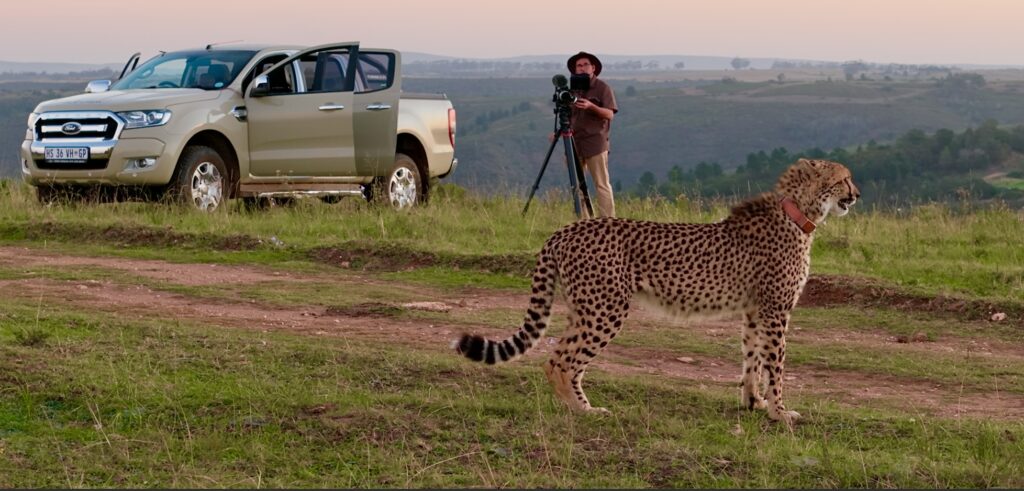
At the same time, we’re introducing Lily and Iris as the two main characters within that space. So it’s doing multiple jobs at once – character development and the science of how they run. Joe had spent multiple days there trying to capture the best running moments on the RED and Daviid the DP was doing some amazing drone work – some synced together, some not. I was pulling from a lot of takes on different days, with different cats, to find the best moments and camera-work, trying to shape it into something that has flow and purpose.
Another sequence that was particularly challenging was Lilly and Iris’s first day when they’re released into the Botlierskop wilding reserve. At first there’s the emotion of the release, their tentativeness, that quickly turns into, “let’s have some fun.” Then the chaos starts – they chase a rhino, trigger a zebra and impala stampede, then provoke a group of Cape buffalo and nearly get hurt. A lot of that was captured on drone, one take, one focal length, and you can’t just cut an entire sequence from aerial footage. So you have to build it out.
That meant punching into the drone footage and back out to create the feeling of coverage, and then layering sync ground-level material as well as supporting visuals from other moments. There’s definitely some “cheating” involved. You’re pulling in establishers, close-ups, approach shots, herd reactions from other days, and stitching it together so it feels like a continuous event.
There were moments where we had corresponding action from different cameras, like RED footage on the ground and drone footage overhead, and I’d find sync points to cut between them. It’s a lot of searching for those connections. That sequence took a lot of work, not because the moments weren’t there, but because shaping them into something coherent and well-paced required a lot of construction.
We also had technical challenges with low-light material. Some of the footage, especially from drones and even from the RED, came in very noisy and initially didn’t look usable. We ended up processing a lot of it using tools like Topaz AI and DaVinci Resolve to reduce noise and recover detail. It was surprising how much we were able to bring back, but it added another layer of complexity to the edit.
One example of this low light material, was Lilly and Iris’s first successful kill, where they take down the black impala. That was built from a combination of clean stalking material and lower-light chase footage. Again, it came down to finding the connective tissue to make those pieces feel like a single, continuous event, but also crossing our fingers that we could would be able to process the footage satisfactorily, one we got into the online phase of the post.
What editing techniques did you use to help audiences understand complex conservation concepts without slowing the film down?
I think the best example of this is in the 52-minute international version for ZDF Studios.
We had two story beats we were trying to fit into that version: the “Cheetah Metapopulation Project” and the “Rewilding of South Africa.” At various points, we thought we were going to lose one or the other entirely, both for time and for flow.
Initially, the Metapopulation sequence was centered around a scene where a group of cheetahs were being darted and transported. We had additional material of cheetahs being darted, crated, and moved, and we were trying to figure out how much of that we actually needed. We were also getting notes to pull back on that material.
What we really needed to communicate wasn’t just the mechanics, but the scale and diversity of the conservation effort. The key idea was that cheetahs are being reintroduced across a wide range of environments in South Africa — very different landscapes, reserves, and terrain. We needed the audience to feel the scope of that.
At the same time, we had all this footage from different locations that wasn’t fitting anywhere and was at risk of ending up on the cutting room floor. So I pitched the idea to Joe: instead of focusing on one location in detail, why don’t we show the bigger picture and use all these places to illustrate how widespread this effort is?
What we ended up doing was merging the two ideas. Rather than having a standalone, topic-driven “Rewilding” sequence alongside the Metapopulation beat, we combined them and essentially elevated the Metapopulation sequence into something broader and more cinematic.
We brought in a map of the cheetah metapopulation as a structural anchor, and then moved through different reserves, showing cheetahs being released and integrated into each environment. It becomes a progression. You start in one location, then move to another, and as it builds, the pacing gradually accelerates.
It’s not quite a montage, but it carries that energy. It starts grounded and then expands into a wider survey. The goal was to give the audience a clear understanding of the concept without stopping the film to explain it in a heavy, didactic way.
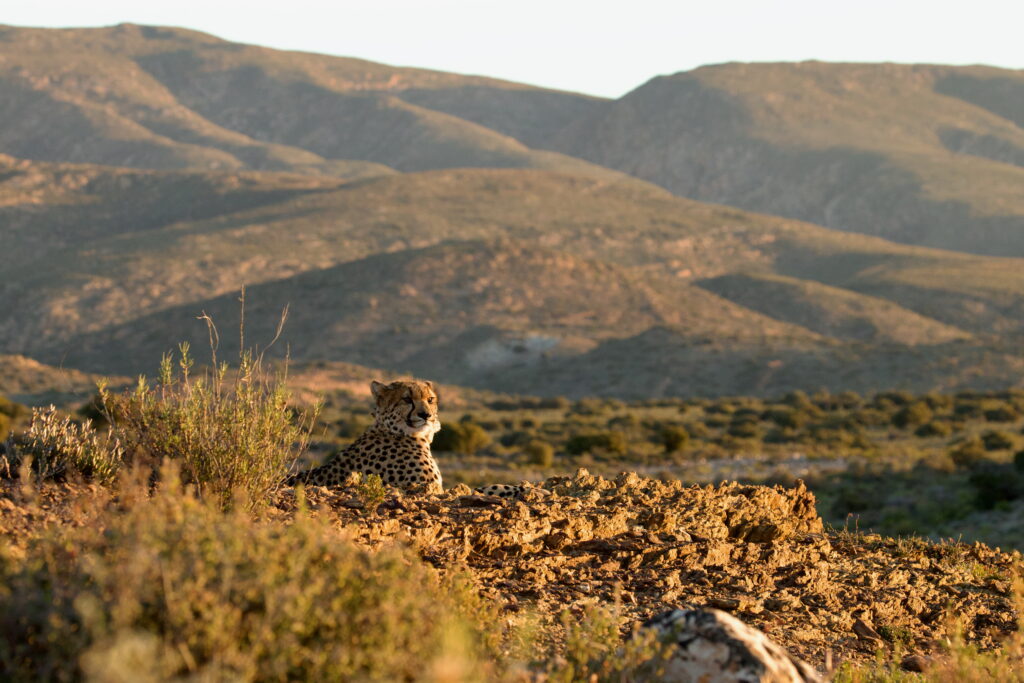
So instead of slowing things down, we leaned into some absolutely stunning visuals featuring the geography and biodiversity of each location — taking the viewer on a quick journey across all seven reserves where the filming took place. The audience gets to see the rewilding of the cheetahs as well as South Africa itself, and the breathtaking beauty of it all. A transformed habitat, and the hope of a cheetah population being given the chance to survive and thrive. We show the system in action across multiple environments, rather than telling it in a single block of exposition.
This was literally the last sequence that we cut for the film. I had been scratching my head about what to do with all those scenes that weren’t going to make it in, all those stunning visuals, and we did a last-minute push to get it in. It was the keystone moment. That sequence ended up being one of my favourites in the film.