
Every production begins with a story. There is an idea, a script, a vision brought to life through sets, costumes, props, and locations. But what happens when the cameras stop rolling? For most productions, the answer has been the same for decades: materials are tossed, sets are demolished, and truckloads of usable goods end up in landfills.
Stacy Morris wants to change that ending.
Based in Ontario, Morris has spent years working at the intersection of production and sustainability, championing a simple but transformative idea: the end of a production should be just as intentional as the beginning. “Everything we imagine has a beginning, a middle and an end,” she says. “We can make the end just as significant and exciting as the beginning.”
It is a philosophy rooted in the circular economy, a model where materials are reused, repurposed, or recycled, rather than discarded. Morris believes Canadian film and television organizations can embed this thinking into their core production standards rather than treating green initiatives as experiments or afterthoughts. The key, she argues, is to think of material reuse as part of the storytelling itself, and to think of circular economy principles as part of the planning when preparing to bring a production to life.
For Morris, the most effective sustainability work does not begin in prep. It begins even earlier. She points to free online tools like PEAR and ALBERT, carbon calculators that allow productions to estimate their emissions before a single set piece is built. CBC, she notes, has made free templates available for productions to use when collecting data for the ALBERT tool. With these resources, a production can examine specific line items on the budget and begin identifying where waste can be reduced or avoided entirely.
“In order for productions to design a reuse and disposal plan during prep, the best place to start is a draft carbon footprint,” Morris explains. “This can be done even before pre-production.”

She acknowledges that not everything can be mapped out in advance. On a pilot or a series where continuation has not yet been confirmed, disposal planning carries uncertainty. In those cases, she advocates for contingency plans that account for multiple outcomes rather than defaulting to the dumpster.
One of the most practical shifts Morris envisions is an expansion of existing purchasing and tracking systems. Productions already have the infrastructure to purchase and monitor spending on props, costumes, and set materials. Morris suggests building on that system by adding disposal options such as donations, recycling, and repurposing for each item. If an item cannot be redistributed, she asks a more fundamental question: can we rent or borrow it instead? Is there a way to avoid acquiring it at all?
When it comes to reporting, carbon calculators again play a central role. The PEAR calculator, for example, includes a metrics summary where materials are recorded by volume, weight, and cost. ALBERT allocates a CO2 emission value for purchased materials. These tools give studios and production companies a way to track and report the volume of materials reused, donated, or recycled in a manner that satisfies both funders and environmental goals.
Morris sees sustainability as a shared responsibility that extends across departments. Location managers, she says, can ensure there are readily available and properly labelled bins for disposal. They can also confirm electrical grid compliance, prohibit vehicle idling, encourage carpooling, and hire locally as much as possible. All this should happen while communicating sustainability goals and initiatives clearly to the entire crew.
Another example is production designers – they can keep the circular economy in mind from the earliest sketches. That means designing sets for disassembly, using products that are less harmful to the environment, and ensuring there is a plan for materials to be reused or repurposed after wrap. It also means choosing vendors who support sustainability and challenging crew members to contribute their own ideas for reducing material waste.
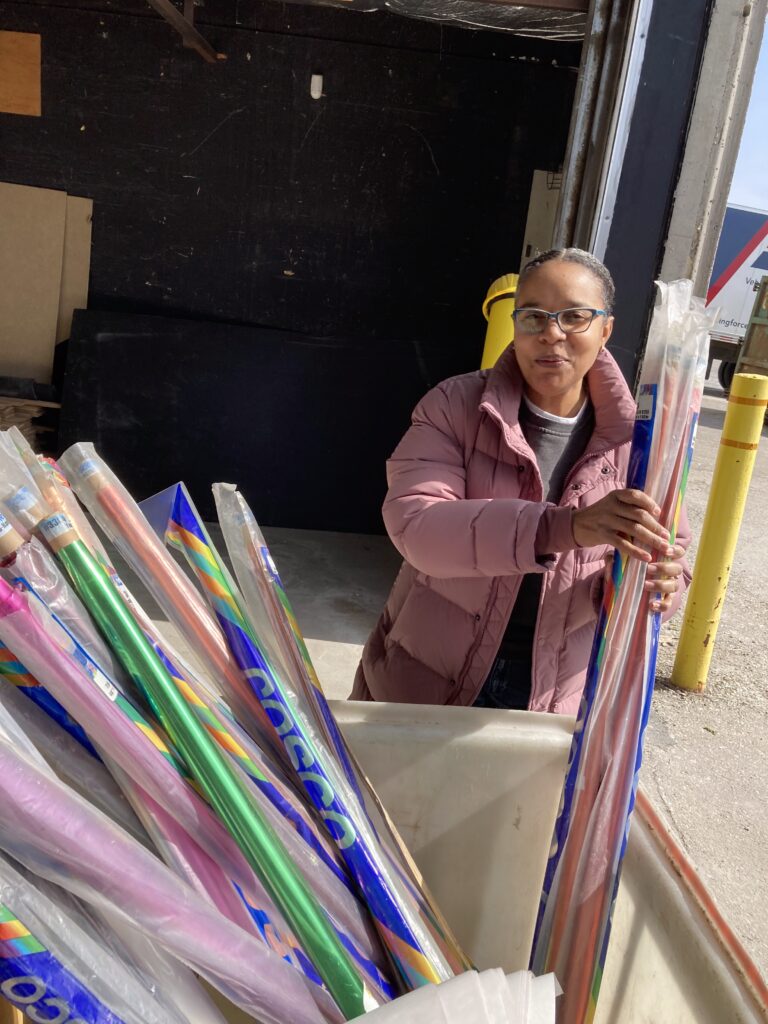
When asked what goals the industry’s guilds, funders, and broadcasters should set around waste reduction over the next five years, Morris pauses. She is careful not to speak for others. But her personal ambition is clear. “A zero-waste mandate is something I would love to see set as a goal,” she says. Her motivation is deeply personal. She wants to do what she can to ensure the earth remains healthy and the industry thrives so that her daughter and future generations can benefit from the efforts being made today to protect both the planet and the careers that depend on it.
Morris is also candid about the obstacles. Sustainability, she says, still feels like a fad or a niche concern for some in the industry. Key financial decision makers tend to sideline green practices when they appear inconvenient or when they cost more than what was budgeted. “Everything is measured in dollars and cents,” she observes. “It is more difficult to measure social benefits and social costs, especially when the impact is not directly felt by the people who make the decisions.”
That is precisely why she believes sustainability committees must not abandon awareness efforts even as they push for measurable change. But committees can also amplify the work of productions that are already leading by example. Even when a committee is not driving the change itself, it can spotlight those who are, creating models for others to follow. The tools exist. The frameworks are available. And professionals like Stacy Morris are proving that sustainable production is not about adding cost or complexity. It is about planning with intention, designing with the end in mind, and treating every material choice as a creative decision.
For an industry built on imagination, that should not be a hard story to tell.
Photo Credits: Isaias Souvervielle, Stacy Morris.