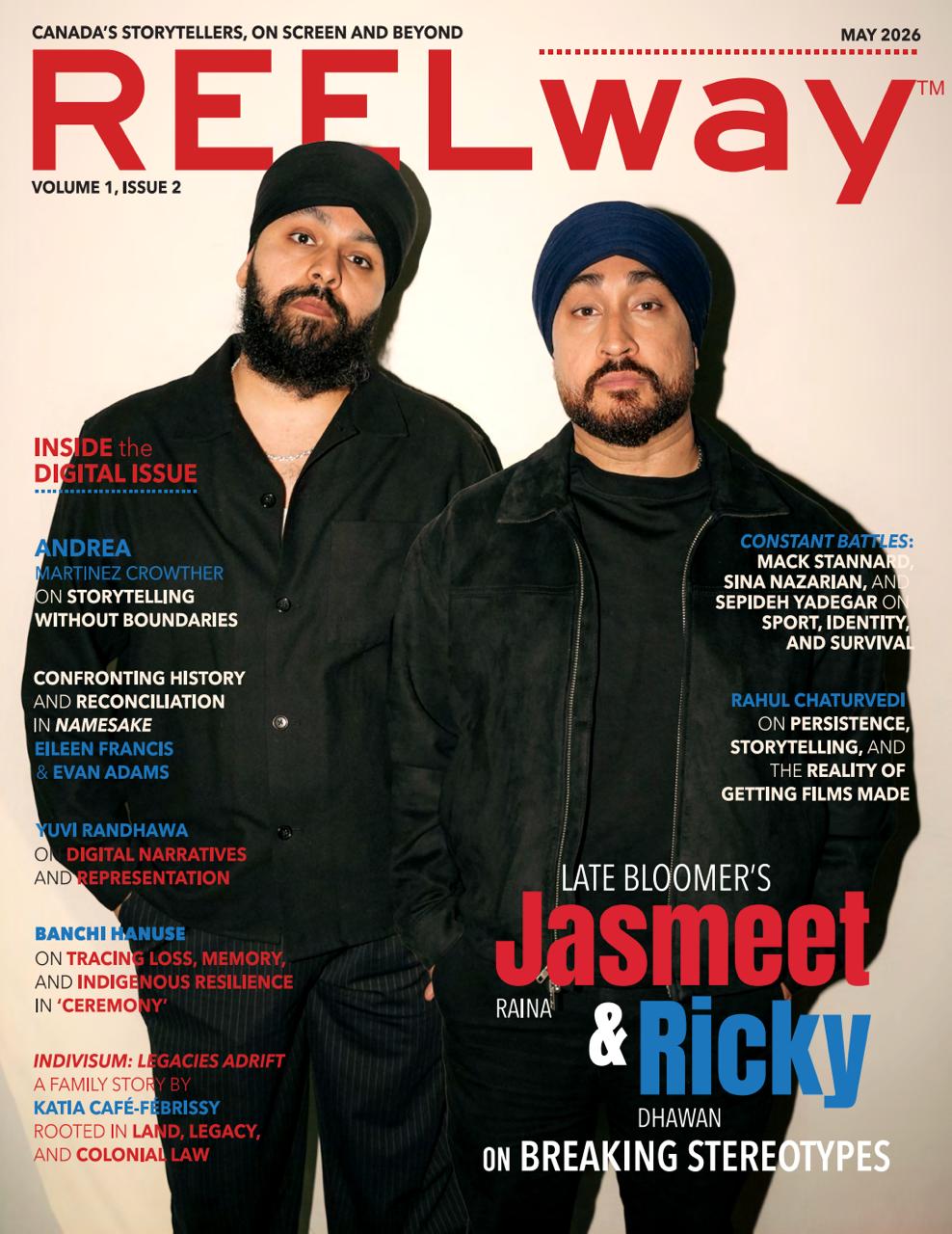
Jasmeet Raina and Ricky Dhawan are no strangers to entertainment. When it came down to the show Late Bloomer, they knew they could bring the funny, the authenticity, and the love for the culture required for the community and beyond to relate to. In this powerful interview with Showrunner/Director/Actor Jasmeet Raina, and Producer Ricky Dhawan, our publisher, Asis Sethi, dives into breaking stereotypes in today’s media landscape. We also explore identity, culture, and authentic representation while sharing behind-the-scenes insights and what to expect in Season 3 of Late Bloomer.
Punjabi Words Used in This Interview:
Nagar Kirtan: “Nagar”, meaning “town” or “city,” and “Kirtan” refers to the singing of hymns. Through processions, Sikhs gather in a public place and sing hymns and perform selfless service.
Panj Banis: Five sacred prayers recited daily by Sikhs in the early morning to start their day.
Daadi: Paternal grandmother.
Pagg: Turban.
Bhangra: A traditional folk dance and music genre from Punjab.
Asis Sethi: Congratulations on the premiere of Season 3!
Jasmeet Raina: Thank you.
Asis Sethi: The first time I interviewed you was in 2010 at the downtown Nagar Kirtan* for a feature documentary I was directing on post-911 effects on turban wearers. And that’s how we first met. When I watched Late Bloomer, especially the 9/11 episode, it brought me back to that memory. You have made sure to keep Sikh representation throughout the show, both the physical representation but also through the challenges the community faces. Now, looking back across that arc, what draws you back to this subject. How has your understanding of identity, visibility, and loss evolved since that first conversation?
Jasmeet Raina: Identity is such a visual part of who I am, whether I like it or not. People that don’t know what the Sikh community is, every time they see me, that’s the first thing they’re going to notice. And then I guess all their judgments are going to have to stem from that. I think identity for me has been such an interesting part of my journey because I just feel like I am who I am, I want to be who I want to be, and I carry myself that way the best that I can.
I think I’d make my identity what I want it to be in the way that I want it to be, and I know everybody else has a different definition of it. Some people are like, you shouldn’t be doing this, but I don’t really listen to that, because if I did, then I could never make comedy.
One of the first things I ever started doing was making comedy. People were like you shouldn’t be a bad guy doing jokes on the internet. And if I really wanted to define myself by their definition, then I would have stopped. I’d be like you’re right, maybe I’m disrespecting the Guru, but that’s not how I roll. I think in order for me to best represent who I am, is to be myself as authentically as possible and live my life based on my purpose. It’s about honouring my journey the best that I can by uplifting myself, and uplifting the people around me, and also be a source of inspiration to others as well.
I have a deep understanding (of Sikhism). My grandfather was a well-known scholar; he’s taught me everything. I went to a Sikh camp. I knew the Panj Banis*. I have a very deep understanding of what Sikh culture, philosophy and spirituality is and I can now define it in a way that feels the best for me. I think we have the freedom to question things and really come to an understanding on our own self.
Jasmeet Raina: Identity is such a visual part of who I am, whether I like it or not. People that don’t know what the Sikh community is, every time they see me, that’s the first thing they’re going to notice. And then I guess all their judgments are going to have to stem from that.
Asis Sethi: And Art is a big part of the Sikh history, whether it’s music or scriptures. Ricky, from YouTube videos to Late Bloomer, you’ve been on this journey with Jasmeet for many years. Did you always want to be in the media industry?
Ricky Dhawan: I watched a lot of TV growing up and I always liked making goofy home videos. I always had a camcorder growing up. The first thing that my dad bought me when we moved to Canada. But he wanted my sister and I to pursue sciences; my dad’s an engineer. My whole family is well-educated individuals like engineers, accountants, lawyers, doctors. But I think for me, I wanted to learn everything. I grew up in a very interesting generation – the early 2000s – listening to Jazzy B, Sukshinder Shinda, RDB. I tried to learn to play a tabla. I didn’t pick it up, right, but I had a love for it?
I got introduced to YouTube through Russell Peters’ stand-up and since then my friend put me on to Jasmeet’s videos back in 2009. I think A1 Shopping Cart was the first video that I watched. And I’m like, this is hilarious!
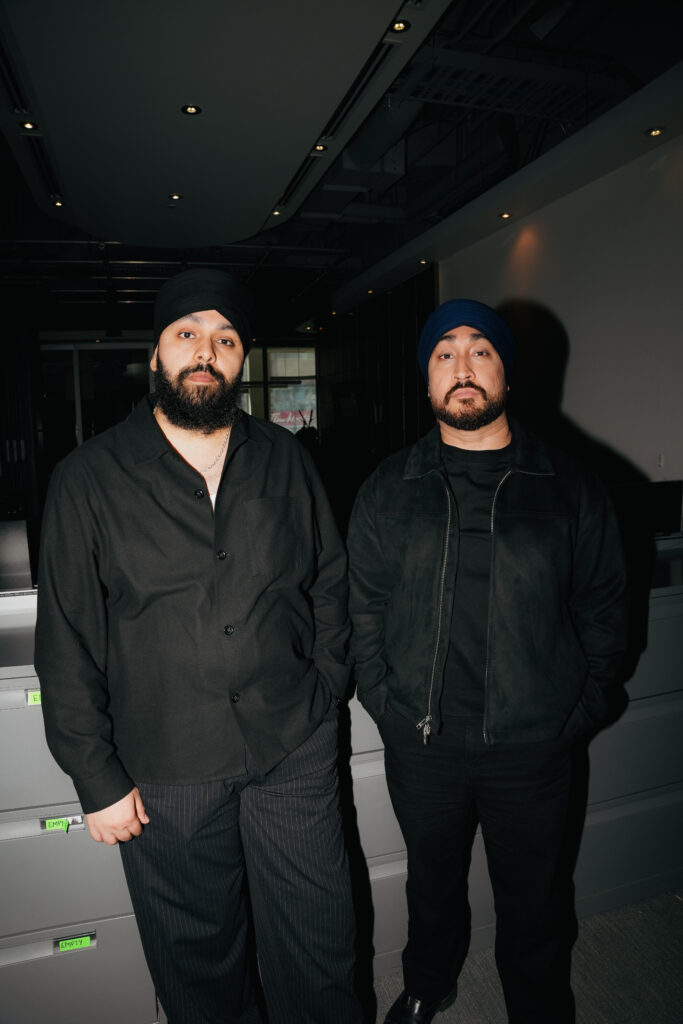
Ricky Dhawan and Jasmeet Raina on the sets of Late Bloomer. Photography by Gurman Singh.
Asis Sethi: That was hilarious! From a person who was on TV at the time, I saw that and I’m like, I’m so thankful that’s not me, it better not be me.
Ricky Dhawan: Yeah. I was in school for accounting when we (Jasmeet and I) met. He was making videos every weekend. We’d go around the campus, shoot some stuff. Then he started traveling, and I started traveling with him, pretending to be his manager and doing whatever came up. There was always a lot of love and passion for the art itself, but I just never knew that it would be even possible to do something like this, and have an actual career. After finishing school, I went into banking and one day my manager just sat me down and said I think your heart’s somewhere else. Since then it’s been full time, and everything I learned was on the field. And exactly what we were talking about, the lack of representation that we had for our community. I want to reach those new heights, because there’s no blueprint for anyone that looks like us. There’s no blueprint for even for our community to be creating things in North America. I think that’s what drives me, and that’s where we went from – YouTube videos on cameras to now doing this show.
Ricky Dhawan: After finishing school, I went into banking and one day my manager just sat me down and said I think your heart’s somewhere else. Since then it’s been full time, and everything I learned was on the field.
Asis Sethi: Wow, what a journey. And for season 3, you bring back the crew, the OGs. I haven’t watched the first episode yet. I will, but I like to watch the whole season in one go.
Jasmeet Raina: I feel you. I do that too. I’m like, what the hell… I’m gonna forget what happened, my memory’s terrible, I’m like, I don’t wanna watch a recap, so I need to watch it in one go.
Asis Sethi: Yeah. Tell me more about the relationship you shared with your team that you’ve brought back for season three.
Jasmeet Raina: It’s like Chaps – I call him Chaps, I don’t call him Ricky. I literally cannot say the word Ricky, it gives me the cringe. He doesn’t even look like a Ricky, he looks like a Chaps!
Ricky Dhawan: Right.
Jasmeet Raina: He’s understood what it takes to get into this, ever since the YouTube days, so it just felt like a natural fit. He understands my brain. We worked with versatile, great, amazing geniuses. But they can also be sensitive, just sporadic, like switch (things) up last second, because (something) doesn’t work or we have to do this instead. And you have to shift a lot of things. It’s like having a team around you that is patient, understands the vision, and is willing to go along with that
Coming into this industry, it’s been interesting and challenging in many ways. You have to try to bring your own people along, and people that want to be in this industry. The industry is like this, this is how things are done, and you need to work with industry writers. And so, in the first season, I had to work with a lot of people that were great, but I wouldn’t have necessarily picked on my own had I known how to do this. So the first season, I was definitely learning how to make a show, and the second season, same thing as well. And going into this season when I understood more, that’s when I stepped up into the role of a showrunner, and started bringing more of my writers into the room, because I’m like, “you guys understand my voice, you guys understand who I am.” My long time friend, Horsepowar, was in the writer’s room in season 2, and she was now in the writer’s room, and on set, as an associate producer. Babu, this time, was in the writer’s room as well. Rupan is in an episode this season and he’s such a busy guy, shooting 500 videos a day. Every time I hit him up, he’s in another country.
We’re always trying to bridge the gap in the TV industry. We had to get actors like Baljinder Atwal. All these dads were auditioning from ACTRA, but we needed a Punjabi father. You’re always encouraged to hire from the union, it’s unheard of to cast outside of the union, and I said we have to. When Baljinder sent his tape, I said, this is my dad. And so the mom (in the show) is actually my cousin. That’s my Massi’s daughter. We just couldn’t find anybody that spoke that dialect. We (Kashmiri Sikhs) are such a small population of the larger Sikh diaspora.
The director that directed half the episodes of this season is a Pakistani queer woman (Fawzia Mirza), and she’s the best – I love her so much. I tell her every time, you’re a blessing to me because of how collaborative and amazing you are. I learned so much from her. She’s such an incredible director.
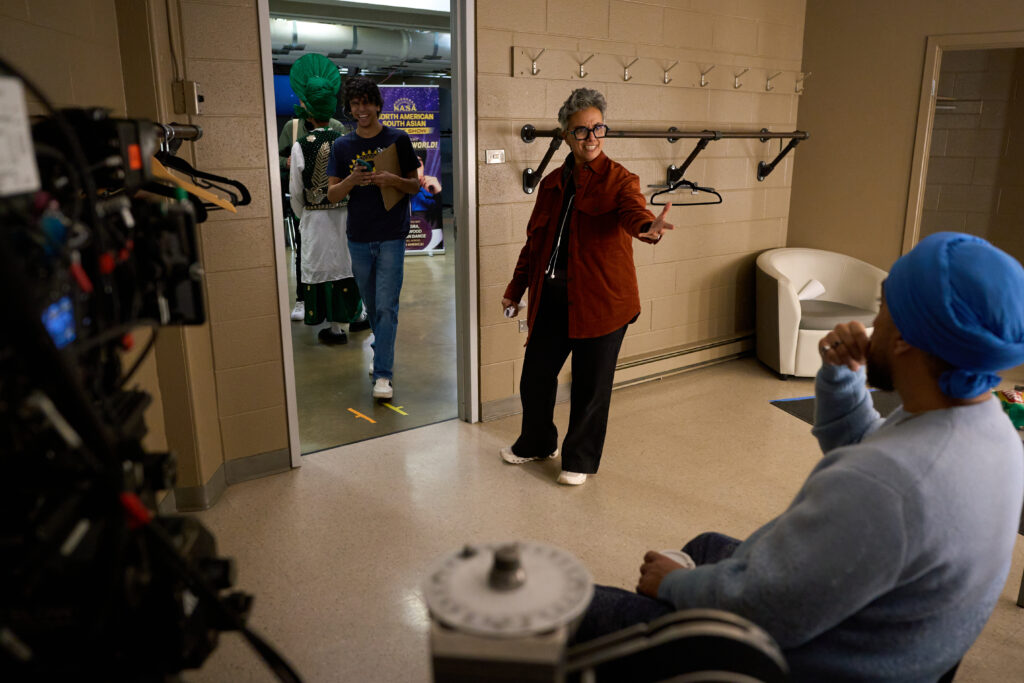
Director Fawzia Mirza (centre) discussing a scene with Jasmeet Raina (right) on the sets of episode 302 of Late Bloomer. Photography by Brendan Adam-Zwelling.
Asis Sethi: When I’ve spoken to my parents, I’ve never spoken in English. They always talk in Punjabi. That’s the authenticity. But it is so challenging to bring that authenticity into our programming, because of all the rules and regulations. How did you manage to keep that balance while maintaining authenticity?
Jasmeet Raina: It’s very tough, the fifteen percent rule, I hate it. But I think what we do is we prioritize the parents first, they speak the most Punjabi, and then the kids. I sacrificed my Punjabi, especially in the first two seasons.
The episode with the international student, I really wanted him and his friends to speak Punjabi, because I wanted that to be authentic. We had a Daadi* character who doesn’t speak any English. Her character is based on my real grandmother, who didn’t speak a lick of English, and she hated it when we spoke English around her because she wanted to understand what we were talking about all the time. She was very snoopy.
You’ll see that in the show this season that we really prioritize speaking Punjabi. But if it wasn’t for the fifteen percent rule, I would make the kids also speak Punjabi with my parents, because I mostly speak Punjabi with my parents.
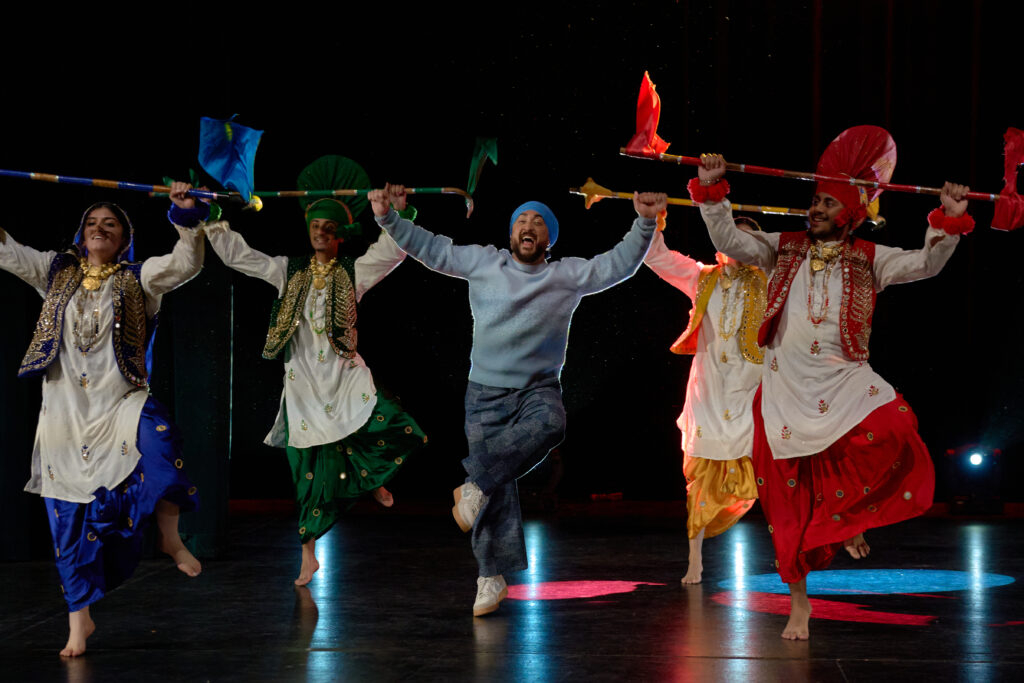
Jasmeet (Jasmeet Raina) joins the Bhangra dancers performing in episode 302 of Late Bloomer. Photography by Brendan Adam-Zwelling.
Jasmeet Raina: You’ll see that in the show this season that we really prioritize speaking Punjabi. But if it wasn’t for the fifteen percent rule, I would make the kids also speak Punjabi with my parents, because I mostly speak Punjabi with my parents.
Asis Sethi: Behind the scenes, it’s so chaotic, especially when you have so many characters wearing turbans, and you want to make sure that the turbans are tied properly. Tell me a little bit about the chaos that goes behind the scenes.
Ricky Dhawan: I would like to take it back to season one when we were learning. We had a lot of flexibility when we were shooting YouTube videos. We can take time, take a break, or come back to it tomorrow. But now you’re wearing the 3 different paggs* in the same space on the same day, and then we’re wearing the same pagg a couple days later. That’s like a minute later in the scene.
So we had to figure out just the pagg side of it so we brought in a pagg tier to maintain consistency throughout. It’s very tedious. There’s a lot of work. We’re doing 10 to 14 paggs a day, and there’s just not enough time for outfit change, especially if you have to add time for the pagg. Sometimes, it doesn’t cooperate and you have to build in time. So it gets very, very chaotic. And especially this season and the last season when Jasmeet is directing and he’s in the scene, and we needed a pagg change, we have someone standing by with extra fabric.
There was a lot of learning in the first season. We’ve been wanting to do an episode where we can show a Bhangra* competition. And we got to do that this year. They (bhangra dancers) all needed to get permits.
It’s always been a challenge, a lot of time and energy goes into it, but when you see it on screen and hear everyone’s feedback on how it’s so cool, it’s the most rewarding moment.
Asis Sethi: We’ve talked about representation, authenticity; it came up throughout our conversation. At what time did you feel that it’s not just a series, but a representation of the community, a platform to voice issues that affect the community, while also making sure that your audience is still emotionally invested in what you’re showing in the story.
Jasmeet Raina: First and foremost is being as truthful as you can and then do the best work that you can, and everything else comes out of that. I don’t ever want to make a show that feels inauthentic, like I’ve seen on so many shows about brown families. I want to create something that actually feels real, that I would enjoy watching myself, and people around me would enjoy watching. I really want to strive to make it as authentic as possible, so the broader audience can understand it and really get into it. It’s a universal story, they can really connect to it. And I operate from a space of being extremely vulnerable.
I think just me having gone through my own journey with my relationship with my family and my parents and doing therapy, all these things that are very uncomfortable. Having done that work and coming out of it, I’m excited that I’ve had these understandings and realizations, and I wanted to put that in the show. And even the show was therapy for me.
In the first season, I was like what’s the worst thing that could happen to me? My nude picture’s leaking, and everyone’s like, you’re an insult to the Sikh community. And I said, I’m gonna do the scariest thing that could happen to me and put it out there.
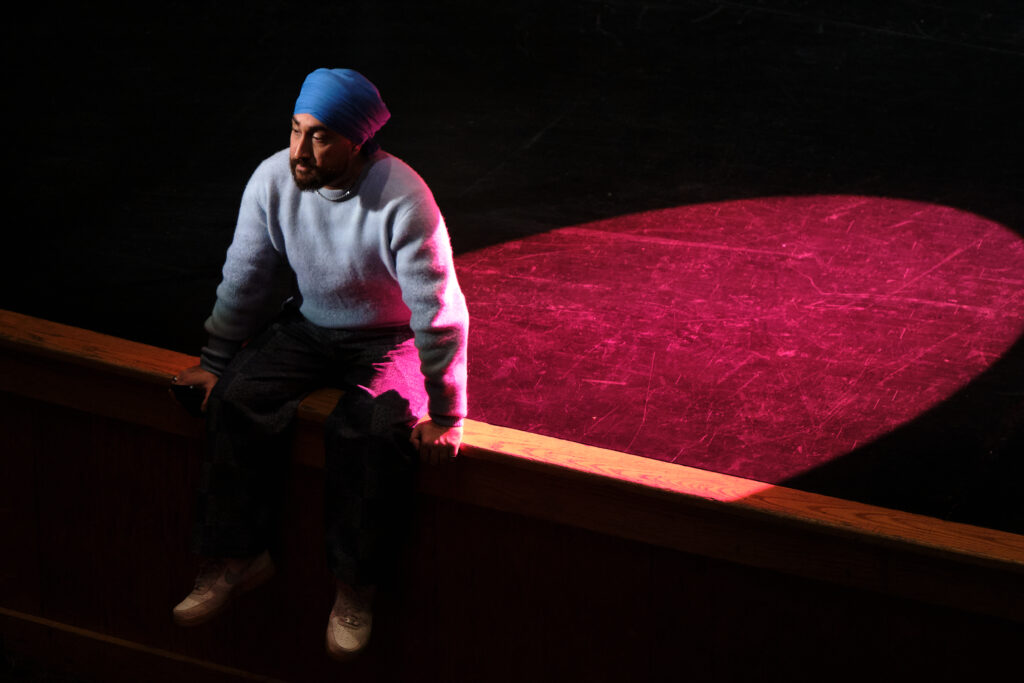
Jasmeet Raina on the sets of Late Bloomer. Photography by Brendan Adam-Zwelling.
If it happens to me in real life, which it probably will, like the show might hit India and other places, and they’ll be like, what is this guy doing? I feel like it’s not gonna affect me anymore, because I went through that on the show. I feel the show has really been giving me a way to process. I’ve received comments from so many different viewers that have said they’ve watched the show with family members, with friends, and they’ve had conversations that they otherwise never would have had.
There are hard things on the show. In season one, you see a physical fight between the father and the son. When I was first writing that, a lot of people said don’t do that, don’t put our community on blast like that. I just chose not to listen to those voices, because I think the greater good of putting something like that out there is more impactful. It will resonate way more in the long run, how they (father and son) cannot communicate with each other, and what the consequences of that lack of communication results in.
I know in my heart of hearts what my intention is; I’m not trying to show the community in a bad light. I’m trying to hold up a mirror to the community; these are some of our issues that we should try to address, and take a look at, and understand. This is a generational thing. We’re at this point now where we can start shifting the curve and start to uplift ourselves in our community, and art is one of the best ways to be able to do that.
Jasmeet Raina: There are hard things on the show. In season one, you see a physical fight between the father and the son. When I was first writing that, a lot of people said don’t do that, don’t put our community on blast like that. I just chose not to listen to those voices, because I think the greater good of putting something like that out there is more impactful.
Asis Sethi: And if we don’t use art to do that, what else do we do? What are you both working on together besides Late Bloomer?
Jasmeet Raina: I don’t like to talk about what I’m working on, but there’s definitely going to be more things for sure. We have a production company now, Nera. We’re just learning how to do productions and take this on. Once we really understand it, we’re definitely going to be taking a look at doing more productions, tapping into different ventures, and also try to uplift other artists in our community as well. That’s one of my biggest goals. I know how hard it was for me to get this show, how much I had to fight to get it. I would like to make that path easier for somebody else that I believe has a level of talent, a cool factor, and an interesting story. But I’m also not done yet, either. This is just the beginning. This show is just the beginning.
Asis Sethi: Awesome. Thank you so much to both of you for giving us your time. And congrats again!