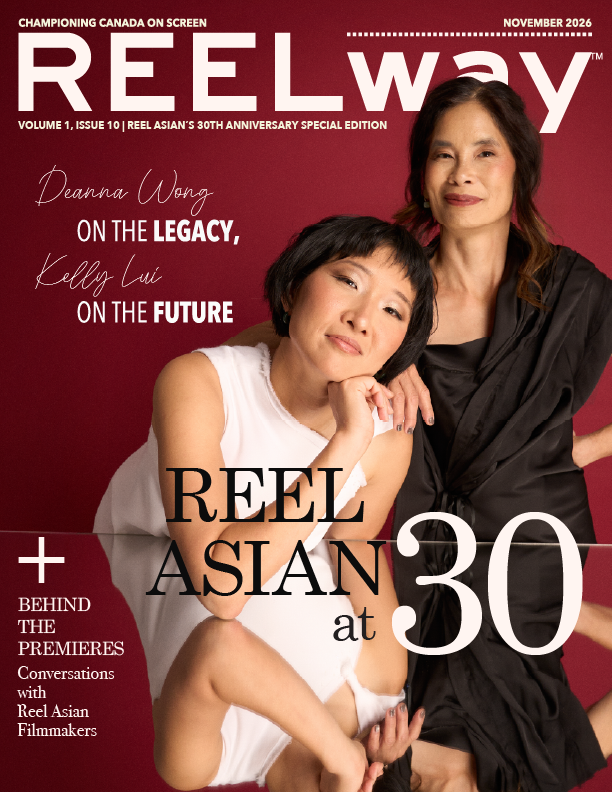
As Deanna Wong and Kelly Lui guide Reel Asian toward its 30th anniversary, they embody both the organization’s history and its future. Wong, who first served as Executive Director from 2005 to 2008 before returning to the role in 2019, has been a key figure in Reel Asian’s transformation from a grassroots film festival into a year-round cultural institution supporting Asian and diasporic storytellers across Canada and the globe. Lui, who rose through the organization as a programmer before becoming Associate Director in 2025, represents a new generation of leadership shaped by Reel Asian’s commitment to artist development and community building.
As Wong prepares to retire as Executive Director, Lui steps into the role, marking a significant leadership transition as the organization looks toward its next chapter. Together, they are helping steer Canada’s largest pan-Asian film festival through a period of growth and renewal, expanding its impact beyond annual screenings to foster mentorship, industry connections, education, and opportunities for emerging creators while redefining what a contemporary cultural organization can be.
Asis Sethi’s conversation with Deanna and Kelly touches upon the history of the festival, the importance of the support that the festival has had and lent to others, and the future of Reel Asian as an organization as it moves forward.
Asis Sethi: First of all, this is such a pleasure. Thank you so much for joining us for REELway, and we’re so excited for this story. I want to start by asking you, Deanna. Wow. 30 years of a legacy that Reel Asian has built now. Tell me more about when you started. You came in 2005, and then you left in 2008. You came back in 2019, and then there was COVID. You went through so many different phases, from where the organization started to where it is now. Tell us about your journey with the organization when you look back through all these years.
Deanna Wong: My journey actually began before 2005. I moved here the year that Reel Asian started, maybe even just before, but I saw that it was happening, and I attended. I first volunteered at a closing night event, and then I joined the board. It was while I was on the board that Sally Lee, the Executive Director before me, left, and I just applied for the job, with very little actual experience.
And then I was Executive Director from 2005 to 2008, as you said. Then I had two kids and came back in 2019, but in between, I still remained in the industry. I was working for an organization called Reel Canada that showed film and did film festivals in high schools across the country. But I also worked in publications, like Reel Screen, which allowed me to go to documentary festivals, and I really loved that. I think I’ve grown with the organization in a lot of different ways.
Asis Sethi: Absolutely. When you were at Reel Canada, was that when the National Canadian Film Day started?
Deanna Wong: It started while I was there. I was there for a few years at Reel Canada.
Asis Sethi: Wow. And your experience with Reel Screen and Reel Canada, how did that help shape Reel Asian in that time period?
Deanna Wong: I was working for Reel Screen, which is an industry magazine for nonfiction and television and film. With that organization, I attended the first documentary festival in Taiwan. Just being in a documentary publication allowed me to remain in the field and get to know a lot of people.
It kept me in the industry. It allowed me to get to know a lot of the players that are still involved. And it just taught me that I really, really wanted to stay in the industry. But when the opportunity came in 2019 to return, my kids had grown, and I felt like there was still work at Reel Asian that I wanted to do. That’s why I came back.
Pictured: Deanna Wong. Photo Credit: May Truong.
Asis Sethi: Awesome. What has been your proudest moment so far, in all these years?
Deanna Wong: Oh, there are so many, but most recently it was the establishment of the Firehorse Award, on the occasion of our 25th anniversary. We named it after our founder, Anita Lee, who was born in the Year of the Firehorse. Establishing that award allowed us to award somebody in the community every year, if possible, to recognize their contributions in the media arts world.
I want to tell you a little bit of history about that. I thought, “[l]et’s establish this award, and name it after Anita.” But I consulted with an advisory group made up of former Executive Directors and former staff, including Anita herself. What we wanted to do was make sure that this award was tied to a significant cash award, to draw attention to the fact that it’s a $25,000 cash award. We also wanted to draw attention to the fact that there are people who have done a lot of work behind the scenes over the past 25 years of the organization and have never been recognized. We wanted the mainstream to see that this work had been done. These people not only have an excellent body of work, but they’ve also mentored and made sure they kept the door open and helped people up along the way. So I’m really proud of the recipients we’ve given the award to. I think what it’s done is renewed interest in their careers and the work they’ve done. And the cash award, which we got Sandra Oh to sponsor, also helps to draw attention. That award has allowed them to continue to do the work they love to do.
Asis Sethi: That’s incredible. The kind of achievements Reel Asian has had since its inception – there are so many milestones that I don’t think any other organization has achieved. You started with a festival, but you realized that wasn’t all you could do. You started mentorship. There are networking opportunities. There are education opportunities. There’s pitching. There are so many opportunities for Asian filmmakers to get the stage they need. When in this journey did you feel there was a big need for all these additional opportunities to be created for filmmakers?
Deanna Wong: If you go through the program guides, right from the beginning, this was never just a festival to show films. Anita and the advisory group from the beginning had panels and master classes right from the start. One of the first ones was about making your first feature film. The foresight was there from the beginning. It was very important to the founders to make sure that filmmakers were being connected and introduced to industry professionals, because this is all about networking and creating opportunity.
I think we’ve really grown with the festival over the years. We started a lot of things when I started, in 2005, like establishing an industry series with ‘Filmmaking 101’, a master class with ‘Your First Script’. But over the years, we’ve seen the need come from the community. They needed to level up, and we needed to level up along with them, so we offered them the ‘Unsung Voices’ program for emerging artists. That’s for beginner, entry-level filmmakers. Our pitch is for the step beyond that, for their next project. And the Firehorse Award is for our established filmmakers. I feel like we have been doing things the whole time to try and keep up with our community and what they’ve asked of us.
Kelly Lui: Speaking to who Reel Asian serves, it’s much larger than just the filmmaking community. It’s much more than just the director, producer, and writer roles. We’re really thinking about Asian creatives and the talent that work below the line, for example, who may not get the same visibility. What are the ways they can also see Reel Asian as a place for them? I think with the Firehorse Award, what’s so special is that it honors media, Asian Canadian media arts’ visionaries. Our last recipient, Anna Serrano, did work around digital spaces, from a different point of view than just a creator. Reel Asian is more than just the film itself.
Deanna Wong: What we are always trying to do is give opportunities to those in our community who are not supported by their own communities for careers in the arts. Up until a certain point, we were always about the filmmaker. But in the last several years, we’ve been trying to let the community know there are below-the-line jobs available. We want to educate them that these are things they can do in the industry, as well as elevate the people who are already in the industry. We want them to know they can work on a film and not have to be the director or the writer or the actor.
Asis Sethi: That’s great to see, because we always think about the writer, director, actor, and even the producer. But we forget about below-the-line: the hair and makeup, the gaffer, the editor, and so many others. Even though editors, for example, are also department heads, we still sometimes fail to recognize them. It’s such a great thing to see that Reel Asian has also empowered them and given them space to create and be showcased, which is amazing.
I also want to ask you, what advice would you give to Kelly that you wish you had received when you started with Reel Asian?
Deanna Wong: I guess it’s something along the lines of: it’s easy to let this job consume you and take over every aspect of your life, and you should try to create boundaries for yourself. It can affect your personal life. You could spend every hour of your day doing something. There are always things left undone. But on a broad level, that’s what I would say. I wish somebody… Well, maybe people did say that to me, and I just didn’t listen.
Asis Sethi: And Kelly, what do you think Deanna has built that you would want to keep and maintain? And is there anything you might want to rethink for the next coming 10 years?
Kelly Lui: Oh, there’s a lot. There’s a lot to say, but just tying it back to the ecosystem, when I started working with Deanna in 2019, what was so formative for me was, one, I actually think she’s very rebellious, in her own way. When you’re starting your career, you’re given guides to just follow. Working with her and alongside her, Deanna, you’ve always been like, “[t]his is how things are done, but you can also do things differently.” Or even just opening up how I might want to see what Reel Asian can be.
I think back to that ecosystem. I know you’ve talked about the Firehorse Award specifically, but I’m also thinking about other types of partnerships we’ve been able to invite in, like working with TACLA (The Asian Canadian Living Archive) to form the Youth Critics Initiative. I think just seeing the need for that, and allowing staff to take on projects we wouldn’t have thought would be something Reel Asian could encompass, has been really formative for me.
And even now, something I constantly learn from you, Deanna, is the relationship-building and how important that is. Coming at it from a very abundant mindset, as things ebb and flow or as organizations have more capacity or not, there are things we can continue to offer and invite in. We’re only stronger if we work with our partners together and continue that forward.
Something I’m rethinking, building on Deanna’s words of wisdom, and I don’t think this is just Reel Asian-related advice, is that anyone who works in film, in film festivals, or in an arts organization knows it’s tiring work. We’re so passionate about the work we do. The way we value it is unlike many other industries, where you can concretely say, “[t]his is what this is worth.” You can’t always measure that kind of value. Something I want to rethink is what sustainability looks like. Not just for the creatives in the industry and how we’re trying to build a foundation for them, but for staff and for the next generation. It’s weird to think that I’m already seeing the next generation of staff coming in, with their energy and ideas and what they’re building upon. I’m constantly amazed, and I wonder how we keep fostering that. For me, that’s the most important thing I want to rethink, shift, and really pay attention to.
Pictured: Deanna Wong and Kelly Lui. Photo Credit: May Truong.
Asis Sethi: Great. I want to touch on representation. We always talk about representation wherever we go, but what does true representation look like for Reel Asian? Especially when we talk about Asia, you’re covering so many different communities. It’s not just one community. How do you maintain that balance? How do you make sure every community is represented through Reel Asian? Thinking about representation from both angles: representing Asians on a global stage, on the Canadian stage, and making sure there is representation of all the communities that Asia covers.
Deanna Wong: That’s a constant struggle. Maybe “struggle” is a strong word, but we’re mindful of it. We started out as a primarily East Asian festival, and that’s evolved over the years. There’s a lot I could say about the process of becoming the Pan Asian festival that we are now. What I’ll say is that we put emphasis on self-identification. We put the emphasis on filmmakers who apply and self-identify as Asian, and then we consider their programming. We try to be as representative as we possibly can in every aspect of our organization, inside and out. It’s hard. With our limited resources, you only have a limited amount of programming.
Kelly Lui: I want to shift away from “true representation,” because the “true” part is probably what won’t be achieved. But I do think at Reel Asian it’s about intention. It’s also a lot to do with ongoing conversations. I still think about a Q&A we had in 2019 for a film we screened at the festival. We were hearing what the audiences were asking, and we realized, “oh, this is still a gap in terms of what programming is.” It’s being okay with the idea that we’re never going to be perfect. It’s ongoing work, an ongoing commitment. What we have achieved might be hard to see when you’re only coming into it for one event, or when this is your first chance to attend the festival. But it’s a thirty-year history, and there’s more. That also means there have been ongoing conversations. Going with the relationship-building, it just takes time. When we talk about representation, how do we do it in a way that is intentional and meaningful? It’s something we do with a lot of care, and also something we pave forward, the further relationships we can showcase.
I also wanted to talk about the way we have now identified what Asian eligibility means. Before, it was very region-based, very country-based, maybe a list of countries. But as we know, borders are very colonial and imperial, and they have those histories behind them. For us, it’s not just about country. We’re really thinking about how Asian identity is much more open, and we’re still trying to be more global. We want it to be a more nuanced conversation than just a definition.
Asis Sethi: I also feel that, especially now, without partnerships, you can just stay in a silo and within yourselves. Partnerships allow you to spread awareness about issues Reel Asian might be covering, or things you want to reach a full Canadian audience with. How have partnerships helped Reel Asian throughout these years? And when did these partnerships actually begin?
Deanna Wong: Right from the beginning. When Reel Asian was established – this was discussed in a book we published for our 10th anniversary. There was an interview between Anita and Cameron Bailey, now head of TIFF, about the cultural wars going on in the ’80s. A lot of the films we showed at the very beginning were about identity and how we fit into mainstream society. Even when Reel Asian was established, they recognized that all of the other festivals and organizations that were culturally grassroots-based needed to work together. We had the same issues we were fighting to have recognized, and we had to be at the table in the film and television industry. We needed to work together. They were working in the realm of intersectionality before that was even a term, and of allyship. Our programming reflected that. There were LGBTQ films, and we partnered with other organizations. From the beginning, we recognized there were themes we shared that would be important and recognized by other communities. We invited them to come to the festival.
It has become much more formalized in the last 20-plus years. If we partner with ‘Inside Out’ or ‘ImagineNATIVE’ on films, we invite their Executive Directors to come and introduce certain film programs. It allows them to introduce their festivals to our audience, and vice versa.
Kelly Lui: To expand on that, at the larger level, it’s interesting to be a festival now. If I can speak to the pandemic, or other initiatives Deanna has been part of, like an ongoing fall festivals group, it’s always been important that we do our work, but we don’t exist alone. We are not the only festival in the city. Many of us have a similar vision, and though the communities we serve may overlap or may be different, we are still very aligned in intentions, spirit, and energy. Partnerships and collaborations are really important. I’ve been really lucky that, when I first started as a programmer, I was able to form friendships with fellow programmers at other festivals. Then we started thinking: our work, the films we’re talking about, and a lot of the artists we’re thinking about – we share those. What would it look like to actually co-curate together? That also reflects the ongoing history of both festivals, and we can reintroduce older titles and newer films at the same time for our audiences to see the works. Even for the filmmakers – to see their works recontextualized.
Pictured: Kelly Lui. Photo Credit: May Truong.
Deanna Wong: It encapsulates what’s going on. But I also want to say, we are a festival that embraces a lot of communities. We represent a lot of communities, and Toronto is a city of festivals. For quite a while, it seemed like every week there was a new festival for Korean films or South Asian films. But we never thought of those as competition. We’ve supported MISAFF, the Mosaic International South Asian Film Festival, which just recently took place. I just want to say we recognize these communities, and we welcome that there are opportunities and platforms for films from all of our communities to be screened to the public. If they can’t come to ours, they can go elsewhere, at a different time of year. The point is that we support our artists, and we want to continue to do that in whatever way we can, with the resources we have.
Asis Sethi: I do want to touch on the rebranding. It’s a great idea, but I want to ask why now, and why did you feel it was important to rebrand?
Deanna Wong: The occasion of our 30th anniversary is the perfect opportunity. We had been thinking about it for many years, actually. Partly, we wanted the brand to reflect how we’ve changed. We are now a year-round organization. We’ve always been around all year, but the programming we offer has expanded. During Asian Heritage Month, we do school tours. We have networking and professional development opportunities during other parts of the year. We do networking during Hot Docs, that sort of thing. We wanted our brand to reflect that openness.
Kelly Lui: We want it to be adaptive. We also want to be flexible. We want to meet our filmmakers and creatives, and our audiences, where they’re at. Having a brand that can reflect that openness, that fluidity, that organic quality is important. To what Deanna was saying, now is the time to do it. It’s been interesting, because I also want to point out that our logo specifically says just “Reel Asian.” Of course we have the festival, but it’s really to point out that we are a year-round organization. As much as the festival is always at the heart of the organization, it’s about how we continue sustaining our creative communities, our audience communities, and our staff year-round, and what that momentum looks like. And not just film.
It’s been really interesting to see the rebrand come to life, and this year in particular, we’re so excited to have audiences see it in full.
Asis Sethi: Amazing. You spoke about community and stories. I’d love to ask: what stories or conversations do you feel are still missing, or still need to be heard?
Deanna Wong: I think there’s still education happening about what a Canadian story is. That’s reflected in the institutional definition of what is Canadian. I think Telefilm, for example, has changed and has been responding to advocacy from within our community, like from Mayumi Yoshida. She’s a filmmaker who made a film that was predominantly in Japanese, about herself, a Japanese Canadian, going to Tokyo for her grandmother’s funeral. Of course it’s going to be mostly in Japanese, but by Telefilm’s definition, it wasn’t initially supported because the language had to be English, French, or an Indigenous language. But then, strides have been made, and progress has been made, and it was given funding. But I still think an education on the broader level of what constitutes a Canadian film and Canadian story is ongoing. It’s not exactly a huge gap, but it’s a gap that still exists among the broader mainstream audience that we’re trying to build.
Kelly Lui: And to that end, something we’ve had to do a lot of education on, even for ourselves, is to change the language we use. Previously we may have said things like “Asian cinema” and “Asian stories,” and we’re now rethinking that. If you ask me, I don’t know what “Asian story” really means. We don’t want the identity to dictate the storytelling a creative can tell. It’s really about how we set them up so they can be bold, genuine, intentional, complex, and nuanced. Those are the stories we want, and we want our creatives to feel permitted to be funded, supported, platformed, and able to keep telling stories in different formats as well. That’s something we’re constantly thinking about.
Pictured: Deanna Wong and Kelly Lui. Photo Credit: May Truong.
Asis Sethi: Lastly, I want to ask both of you a question. Deanna, from all your experience over so many decades, what would you like to leave behind for Kelly?
Deanna Wong: From the point of view of the organization, what was really important to me was to leave behind… to quote Anita, actually. I was reading what she said, and it fully encapsulates what I feel, which is to leave behind an infrastructure that’s solid, some stable organizational funding, and a committed group of people to carry on what Reel Asian has been doing. I’m so proud, because I really think that has been achieved. Kelly actually started the year before I came back in 2019. Her contract was ending when I started, and I immediately was able to find a way to keep her. It was important to me that there be continuity, that we’re not constantly reinventing the wheel, and that people who care about the festival stay on and carry it on. That’s what’s most important to me.
Asis Sethi: And Kelly, looking back 10 years from now, what do you hope you would have changed, or achieved, in the next 10 years?
Kelly Lui: That’s such a big question, but I’m going to talk about the nimbleness of the organization. I’m not yet 10 years in, but I’m approaching that. Just seeing how we’ve had to adapt, with things changing in the world, in the industry, constantly changing. How do we build a structure, or continue on a structure, that can respond, not just responsively, but reactively, I suppose? We are nimble, we’re adaptive, we’re flexible, in that we are constantly learning alongside our creatives, our audiences, our fellow partners in the industry, and the larger community. I hope we can still go on that journey together. For me, that’s what I would hope for.