
As part of the REELway X SACFF Canada/India Co-Production Lab Series, REELway spoke with the Canadian filmmakers participating in this groundbreaking initiative. Through these conversations, the filmmakers share their creative practices, experiences navigating the Canadian film industry, and perspectives on the possibilities of international collaboration. In this interview, producer Joe Balass chatted with Shwayta Sharma about three decades of producing fiction and documentary in Canada, the evolving landscape of film financing and distribution, and the importance of building international partnerships rooted in creative compatibility and trust. Drawing on his extensive international experience, Balass also explores the opportunities for Canadian and Indian filmmakers to create meaningful collaborations that are creatively driven, culturally connected, and built to reach audiences across borders.
You’ve been producing in Canada for almost three decades across both fiction and documentary. What has changed most in the way Canadian producers develop and finance films?
The biggest change is that financing and distribution have become much more complicated. You are developing the entire ecosystem around the film: the creative team, financing strategy, co-production structure, audience and market positioning.
Today, particularly for independent features, you often have to think about financing, audience, distribution and international partnerships from very early on in the process and have a strategy for breaking through the noise in a very competitive landscape while also preserving your artistic integrity and vision.
At the same time, there are more opportunities for co-production. Canadian producers can access provincial and federal funding, tax credits, broadcasters and distributors, but international co-production can open additional creative and financial possibilities. The challenge is that financing has become more complex and producers have to understand several systems at once.
You’ve built longstanding international relationships through your work. What have you learned about building successful creative partnerships across borders?
I’ve learned that the best international partnerships begin with creative compatibility; it’s not just about the money. Obviously, financing matters, but if the relationship begins only because one producer needs access to another country’s funding, it can become very transactional. The strongest partnerships happen when both producers genuinely understand the film and bring something meaningful to it.
And then there is trust. International films can take years to finance and make. You need partners with whom you can have difficult conversations and still want to have dinner afterward. That human relationship is incredibly important.
When Canadian producers look toward international markets, what do you think they often get wrong about finding the right creative or production partner?
Sometimes we start by looking at a map rather than at the film. A co-producer shouldn’t simply fill a requirement column. Ideally, they make the film better and expand the possibilities of where it can travel.

Still from ‘Calorie’.
Canada and India have very different film industries, audiences and financing structures. Where do you see the greatest opportunity for collaboration between the two?
I actually think the differences are part of the opportunity. Canada has a strong public financing ecosystem, experienced crews and a long tradition of international co-production. India has an extraordinary filmmaking culture, enormous audiences, exceptional talent and a film industry operating at a scale Canada simply doesn’t have.
There is also a large and sophisticated South Asian diaspora in Canada. That creates opportunities for stories that genuinely belong to both places rather than simply being “Canadian films set in India” or “Indian films with a Canadian component.”
I saw that firsthand producing ‘Calorie’, which we shot in Montreal and India. The most interesting possibilities come when the two cultures are embedded in the story itself. There is enormous potential in character-driven films about migration, family, food, identity, generational change and relationships between South Asia and the diaspora. Those stories can be culturally specific while still being very universal.
Tell us about the project that you will be developing through the lab. What kind of producer are you looking for in a potential co-production?
The project is ‘Something Delicious’, a dramatic comedy directed by Eisha Marjara. It will be our fourth film together!
It follows a young woman in Delhi who dreams of becoming a great chef and saving her father’s struggling crêperie. She travels to Montreal to study with Chef Kabir, a celebrated chef she has idolized for years, only to discover that her hero may become her greatest adversary.
At its heart, it’s a film about food, family, and having the courage to find your own path. A young Indian woman in a world that is rapidly evolving: food, an impossible mentor, family expectations, Canada and Delhi, and the discovery that becoming successful means finding one’s own recipe rather than copying somebody else’s.
The film moves naturally between India and Canada and combines Hindi and English, so a Canada–India partnership feels organic to the story rather than imposed on it.
I’m looking for an Indian producer who has strong creative instincts as well as production experience, someone who understands the local audience and industry, but who is also excited by an international collaboration.
I don’t simply want someone who can execute the Indian portion of the production. I’m looking for a genuine partner who can help shape the film, challenge us creatively, and help determine how the project should live in India as well as internationally.
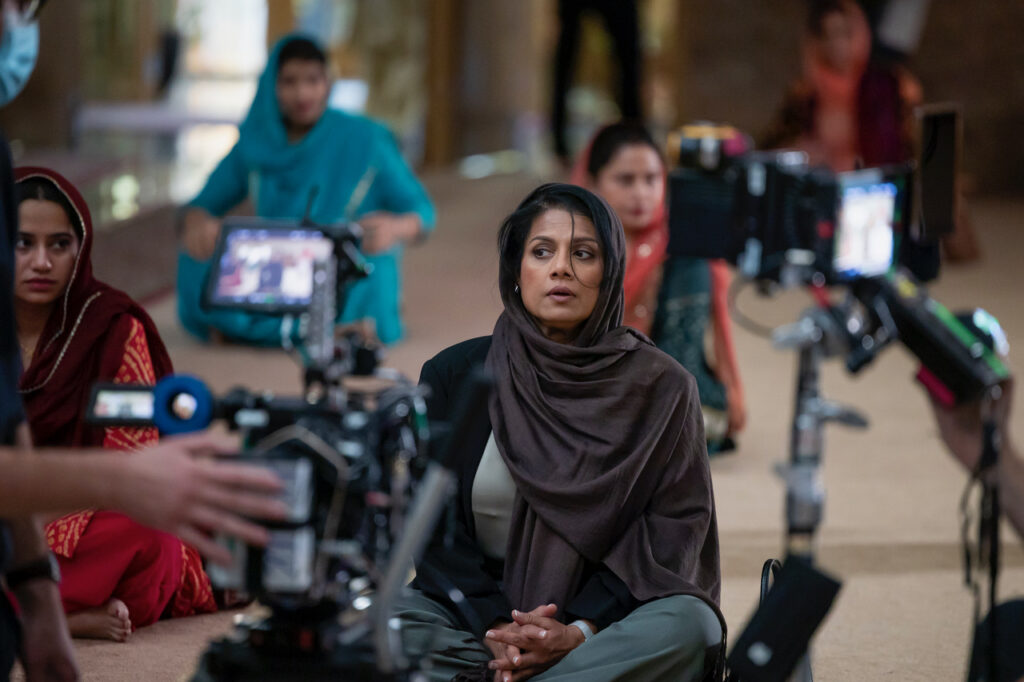
Still from ‘Calorie’.
What makes an international co-production work creatively, not just financially, and how do you know when the partnership is right?
You know fairly quickly whether you are talking about the same movie. Two producers can look at exactly the same screenplay and imagine completely different films. That doesn’t mean either one is wrong, but it probably means the partnership will be difficult.
For me, the right partner understands the tone, the ambition, and the audience of the film. They should also bring another perspective. I don’t want a partner who agrees with everything I say; ideally I want somebody who makes the project stronger. And because these projects take years, there also has to be generosity, transparency and a sense of humour. Those qualities become almost as important as financing.
QUICK TAKES:
Q. What projects are you currently pitching or developing?
I’m currently working on several features at different stages. ‘Mary, Mary’, by Bruce LaBruce, is in final financing as we move toward production; ‘Something Delicious’, directed by Eisha Marjara, is being developed as a Canada–India project; ‘Santo Cabrón’, also directed by Bruce, is being developed as an international Canada–Colombia co-production; and Farida is an ambitious historical drama set in 1930s Baghdad which is still in script and development phase. In addition, I’m also developing the French-language feature ‘Un futur radieux’ with a couple of wonderful filmmakers from Québec.
Q. What stage are these projects in (writing, pre-production, post-production)?
They span the whole pipeline:
‘Mary, Mary’ is in final financing and packaging and moving toward production. ‘Something Delicious’ and Santo Cabrón are in advanced development. ‘Farida’ and ‘Un futur radieux’ are in development.
At the same time, we continue to work on the release and international life of our completed films, including ‘Calorie’.
Q. What kind of collaborators are you looking for right now?
Primarily international co-producers, financiers, distributors and sales partners, but also actors and creative collaborators who connect strongly with the individual projects.
For ‘Something Delicious’ specifically, I’m very interested in meeting Indian producers and sales agents who understand both the domestic Indian market and the international co-production and distribution space.
For the broader slate, I’m also interested in European and Latin American partners.
Q. How can people get in touch if they want to collaborate or learn more?
The easiest way is through the contact form on the Compass Productions website:
www.compassproductions.ca
I’m always happy to start with a conversation and see whether there is a natural connection between a collaborator and one of the projects.
Q. Are you looking for submissions, funding, or other opportunities?
Right now I’m particularly looking for strategic partnerships around the existing slate, co-production, financing, distribution, sales, casting, and market relationships.
I’m always interested in meeting filmmakers and hearing about compelling work, but the immediate priority is moving the projects already in development toward production.
Q. Any upcoming events, screenings, or launches readers should know about?
We’re continuing the release and international positioning of ‘Calorie’, while preparing the next stage of financing and production for ‘Mary, Mary’. For ‘Calorie’, we are keen on finding distribution and sales partners to bring the film to India, the US, the UK, and Australia as priority markets.
At the same time, ‘Something Delicious’ is moving forward through the Canada–India co-production process, so I’m especially looking forward to expanding the relationships around that film over the coming months.
There are several other projects in the slate that we’ll be introducing to international partners and markets over the next year.