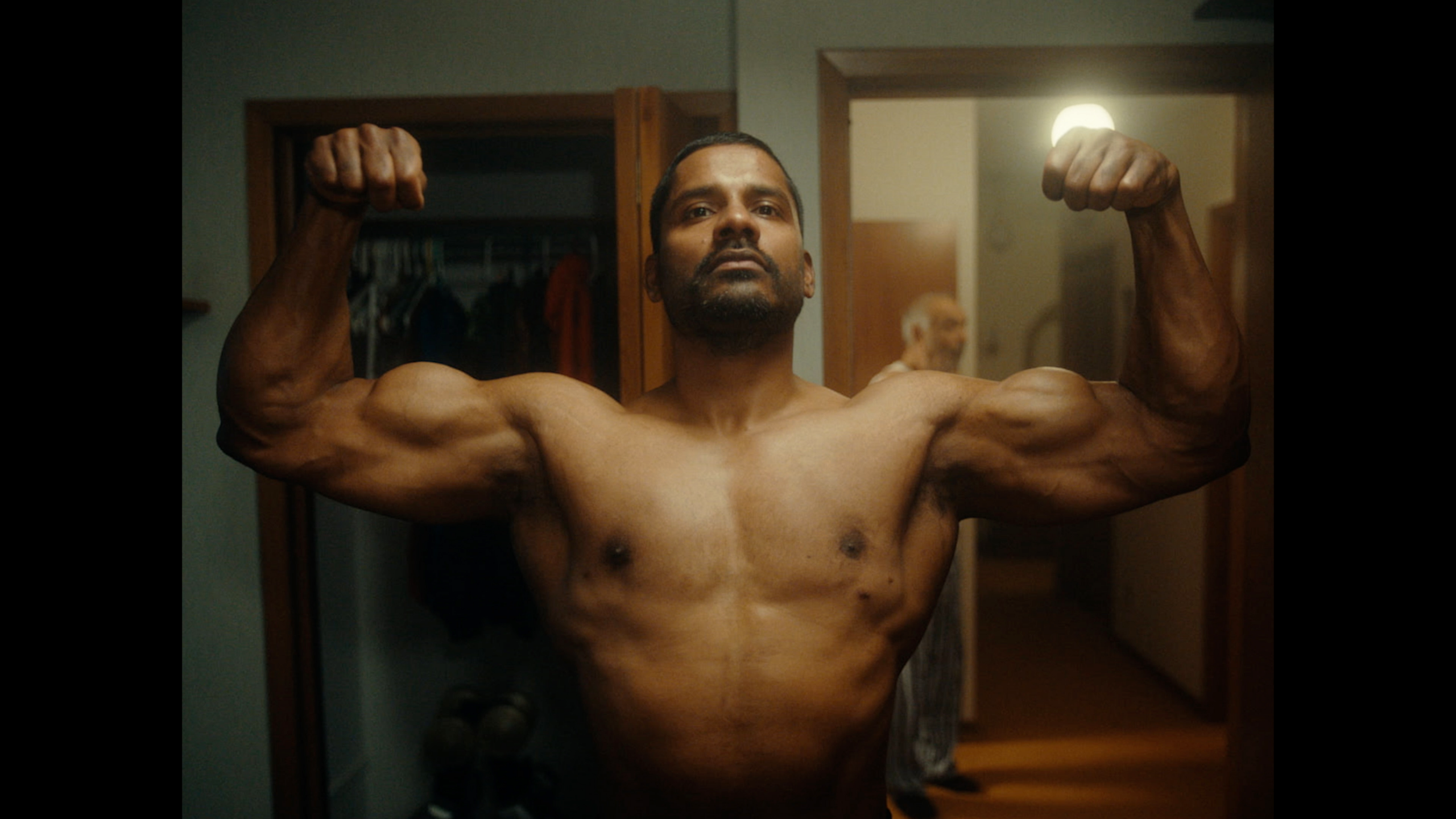
Writer-director Ian Bawa takes a deeply personal look at masculinity, mental health, and the complexities of South Asian father-son relationships in his feature film ‘Strong Son’, which will screen at the Reel Asian International Film Festival this November. Following its beginnings as a short film that premiered at TIFF in 2020, Bawa expands the story into his feature-length directorial debut, drawing from his own relationship with his late father to explore the pressures of cultural expectations, emotional vulnerability, and the often-unspoken realities of caregiving. At the centre is Mandeep Sodhi as Harvinder “Harvey” Singh, a bodybuilder struggling with anxiety and the weight of familial expectations, whose journey toward understanding himself challenges conventional ideas of what it means to be strong.
In this conversation with Kavita Musty, Bawa, Sodhi, and professional wrestler Yuvraj “Raj” Dhesi reflect on the deeply personal experiences they brought to their characters, the emotional catharsis of telling this story, and why sometimes the greatest expression of strength is allowing yourself to be vulnerable.
Kavita Musty: Ian, I would love to know what drove you to decide, “Okay, I’m going to make a feature. I haven’t said my piece. The short film was not enough, and there’s more of an impact that I want to have by making this feature.” Tell me what went into that decision. What did you want to show and tell people?
Ian Bawa: Yeah, the short was kind of like an accident. It was at TIFF in 2020, but it was COVID TIFF, so I got to watch it with my dad on a television at home, with people liking it from their couches. I saw the reviews, and a lot of people had reached out, and it was all great.
He passed away a few weeks after that. Even before it got into TIFF, when I made it, I was kind of like, “Oh, this movie is something.” I always thought, there are two characters: this bodybuilder and this old dad. How did they get to the position where they’re together at the gym?
I was wondering what the backstory was. Then it had me thinking about my relationship with my dad. After he passed away, I didn’t actually know what the movie was going to be.
Actually, we had lunch a few minutes ago, and I was telling them about a couple of the ideas I had for the script, which were crazy. They were still about a father and son, a bodybuilder and an older father.
But it ended up becoming a film about mental health. The three topics I wanted to explore were mental health, specifically my own mental health; cultural expectations, specifically within males and South Asian males; and my relationship with my dad. Somehow, that became a universal theme within this film.
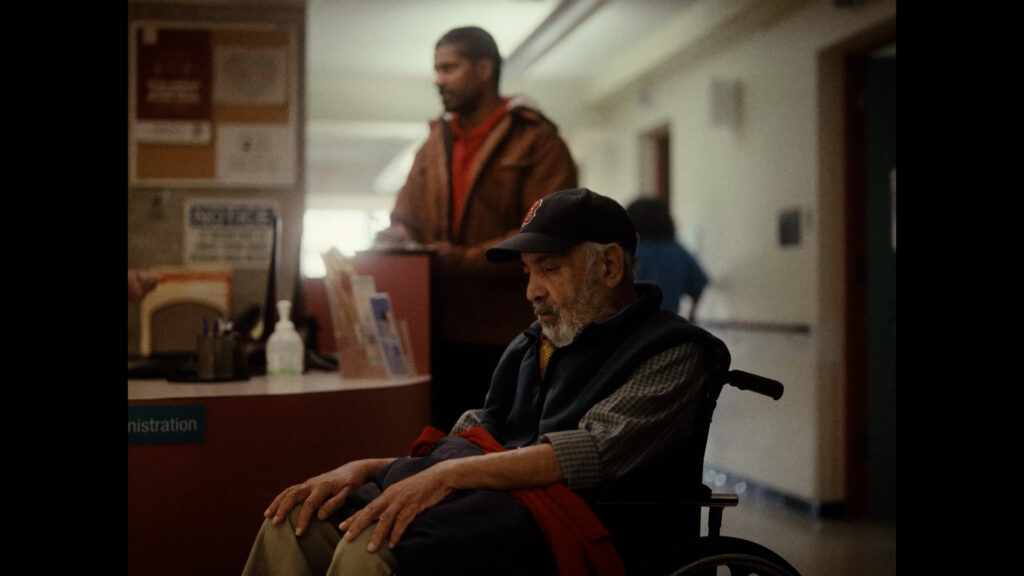
Pictured: Mandeep Sodhi and Amrit Prabhakar.
Kavita Musty: That’s wonderful. Truly, as artists, oftentimes we process our grief through our art. I’m sorry to hear that your father has passed on, but it looks like making this film has also helped you work through all the love and all the grief.
Mandeep, you played Harvey Singh. Congratulations! Your character is very focused on building his body, becoming strong and being a man. But deep down, there’s also a lot of insecurity and anxiety that you’re riddled with. I understand that your father put a lot of that on you, like, “This is what it means to be a man.”
There’s a lot of toxic masculinity, and then you step into a traditionally feminine role of being a caregiver for your father. That’s quite the transition. I’d love to know, what was your train of thought when you were playing all of those different emotions and that kind of trajectory?
Mandeep Sodhi: That’s a wonderful question, first of all, and thanks for having us here. To answer your question, I have played all those roles in my life. I’ve been a bodybuilder for 20 years. I’ve been training for over 30 years. I was my dad’s primary caregiver when he was in the hospital for two months before he passed away.
I realized that, traditionally, men don’t care much, or that’s what we’re told. We’re told not to cry and to hide our emotions. I was drawing on all of those experiences to bring into this film.
I said it before, this was like a catharsis for me to cry and be at peace with my dad, with losing my dad, who I lost 13 years ago.
At the same time, I wasn’t able to travel to his funeral, so I wasn’t present. I had all that guilt riding inside me, which I was able to bring into the film. I’m thankful to Ian for giving me the opportunity. I was able to cleanse all that through this performance.
To make a long answer short, I had lived all those moments that were actually in the film, and I kept telling Ian, “It feels like a chapter from my life.”
Ian Bawa: Okay, so that’s impossible. It’s about me.
Mandeep Sodhi: It’s about him. But that’s so funny that you say that because that is the South Asian family structure dynamic.
You are a man; you gotta do this, you gotta hide your emotions, keep moving. Our mental health is kind of on the sidelines. We don’t care about it much. We don’t even talk about mental health. That’s the commonality we lived with. That’s why I feel like it’s my story, but it’s actually his story.
Ian Bawa: Yeah, it’s my story first (chuckles).
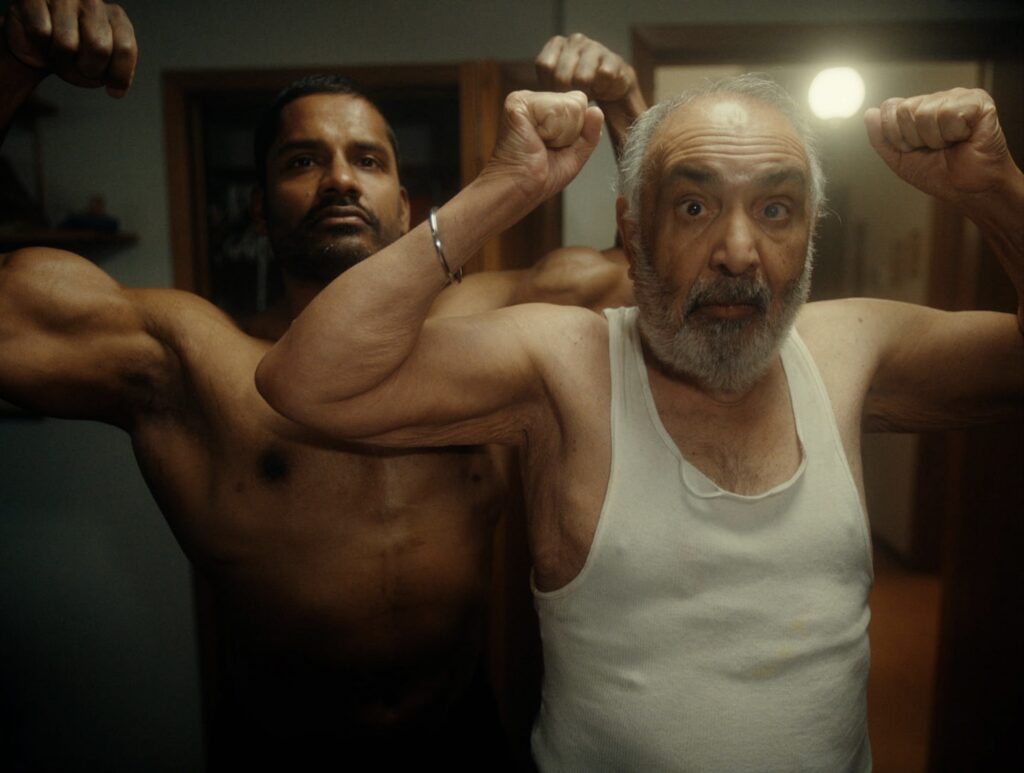
Pictured: Mandeep Sodhi and Amrit Prabhakar.
Kavita Musty: It is definitely Ian’s story first! But it really is lucky that you found Mandeep because his character, the way that you’ve portrayed it, comes from a very real place, as you said. But it’s definitely your story.
Mandeep Sodhi: As a matter of fact, I keep saying that the real thing is we had real weights, real stunts, and real tears. There were no fake weights. Funny enough, they got delivered to the wrong address, so we had to work with the real weights.
I was asked if I needed fake tears. I said, “If I’m gonna feel it, I’m gonna feel it. I’m gonna come from a real place.”
So, real tears. Raj was also courteous enough to teach me how to fall and how to roll. He taught me how to take a fall in wrestling. He was teaching me how to wrestle. All this is real, and thanks to Ian for allowing the space for us to explore that.
Whenever you are trying to do something real, it takes time, and the director has to allow you to take time. Any time there was an emotional scene, I said, “Guys, can you give me two minutes?” He always said, “Take two minutes. Don’t worry.”
I had to get inside my head and inside my heart to find what emotion I could pull from and make it feel real.
Kavita Musty: Absolutely. Raj, thank you for being with us. I am very curious. First of all, have you acted before?
Yuvraj “Raj” Dhesi: Yes, on a television series. I come from WWE, so essentially that’s acting in a way, too. But this is my first film.
Kavita Musty: That’s what I was wondering. So it’s your film debut, and you’ve had an incredible career. You have put South Asians on the map in terms of wrestling. You’re out here representing, and then you step into this film world as Harvey’s friend.
I would love to know, in your process of playing a character who helps him through his panic attacks and anxiety, how much of that really struck you as something you’ve seen before, given your career? How much of his experience have you seen in real life, whether any part of it has been your own or something you’ve witnessed in the people around you? Of course, it’s a stressful career. I’d love to hear more.
Yuvraj “Raj” Dhesi: Yeah, definitely. I’m sure all of us were raised with our dads comparing us to other kids or other people, right?
In a way, Nav is that guy. But in my process of understanding Nav, I also learned that he went through this. He dealt with an aging father and took care of him. He understood the weight of it and the gravity of it. He understood that it’s tough to do it, and if you don’t do it, you feel guilt. So it’s a very tough situation.
What struck me about Nav is that he’s not an antagonist, which he should be. I love this character because he’s not your traditional, arrogant Punjabi guy.
I don’t have that attitude. Again, from Nav’s experiences, which are similar to Harvey’s, he’s understanding, and I think that’s strength. Strength is not putting on this facade and acting like someone else or something else. Real strength is lending out that helping hand and being understanding.
Kavita Musty: That sensitivity’s been informed by your own personal experience. That’s why you’re able to be empathetic, resonate with him, and be that shoulder that he can lean on.
Well, thank you so much. I wish you all the very best for the festival run and beyond, and I can’t wait to go watch it. I will make sure I do.
Ian Bawa: Well, thank you.