Writer-director Nidhil Vohra and actress Zehra Nawab bring a personal story of dreams, desire, and self-discovery to the screen in ‘Dream Girl’. Inspired by Vohra’s mother, the short film follows Kiran, a middle-aged South Asian woman whose Bollywood crush unexpectedly arrives at her doorstep. Beneath its comedic and fantastical premise, the film explores the unfulfilled desires of women who have spent much of their lives caring for others. Developed through Reel Asian International Film Festival’s 2026 ‘Unsung Voices’ programme, ‘Dream Girl’ will make its world premiere at Reel Asian this November. Shwayta Sharma spoke with Vohra and Nawab about the inspiration behind the film, bringing Kiran’s emotional journey to life, and the importance of reclaiming one’s dreams.
The Story Behind Kiran
‘Dream Girl’ begins with a wonderfully fantastical premise: a middle-aged Indian woman’s Bollywood crush arrives at her doorstep and asks to marry her. Beneath the humour, however, is a woman who seems starved of affection and appreciation in her everyday life. What inspired this story, and when did you realize that this unusual premise could become a story about a woman’s relationship with herself?
Nidhil Vohra: The story is inspired by my mother. She has an unshakeable crush on Salman Khan and has seen pretty much all of his films, even the bad ones, of which there are quite a lot. Despite her unwavering belief, love, and admiration for Salman, and her family (in that order), I have seldom seen her extend that same grace to her own self. She was born in a tiny village in India, and as the middle child and a girl, she often had to fend for herself. Hers is a truly singular story, and she’s somehow surmounted all odds to be where she is today, but along the way society established a ceiling for her that she internalized.
As she vicariously lives through her children, I want to remind her that there is plenty more that she can still accomplish regardless of what anyone else thinks. It is this complicated emotion with an equally tangled web of characters involving my mother, our family, Salman Khan, and her internal dreams and desires clashing against the stereotypical patriarchal construct of a typical Indian family that has advised the film’s story. Shryana Bhattacharya’s book ‘Desperately Seeking Shah Rukh’ has also examined a similar idea of Indian women finding relief from patriarchy through the film star Shah Rukh Khan. So, in a way, it is not just the story of my mother but of others like her, who for years have been told what to do and how to live and have found an escape from all of this cultural conditioning in the eyes of a filmy Prem, Rahul, or Raj.
Your character is a woman who has spent years looking after her husband and children, without receiving the same level of care or appreciation in return. How did you approach understanding her inner world, particularly the loneliness and unfulfilled desires that may have become so familiar to her that she no longer knew how to articulate them?
Zehra Nawab: During our initial conversations, writer & director Nidhil spoke specifically about incidents that had shaped and inspired his script. I took that in and built on it by observing different relationships around me and borrowing moments from a few. Journaling thoughts, reflecting on fictional characters & real people that sections of the script reminded me of was a helpful exercise – whether portraying a phase of life, an age bracket, and a state of mind that is different from my own. It helps me when I’m specific in my imagination, building a backstory about my character’s day-to-day life and, more particularly, what her day looks like before the camera captures this tiny slice of her life. So then the emotions don’t exist in isolation, but they find a place within my mannerisms and my body language, and glimpses of emotions existing in parallel can be made possible, which is how it often is in life.
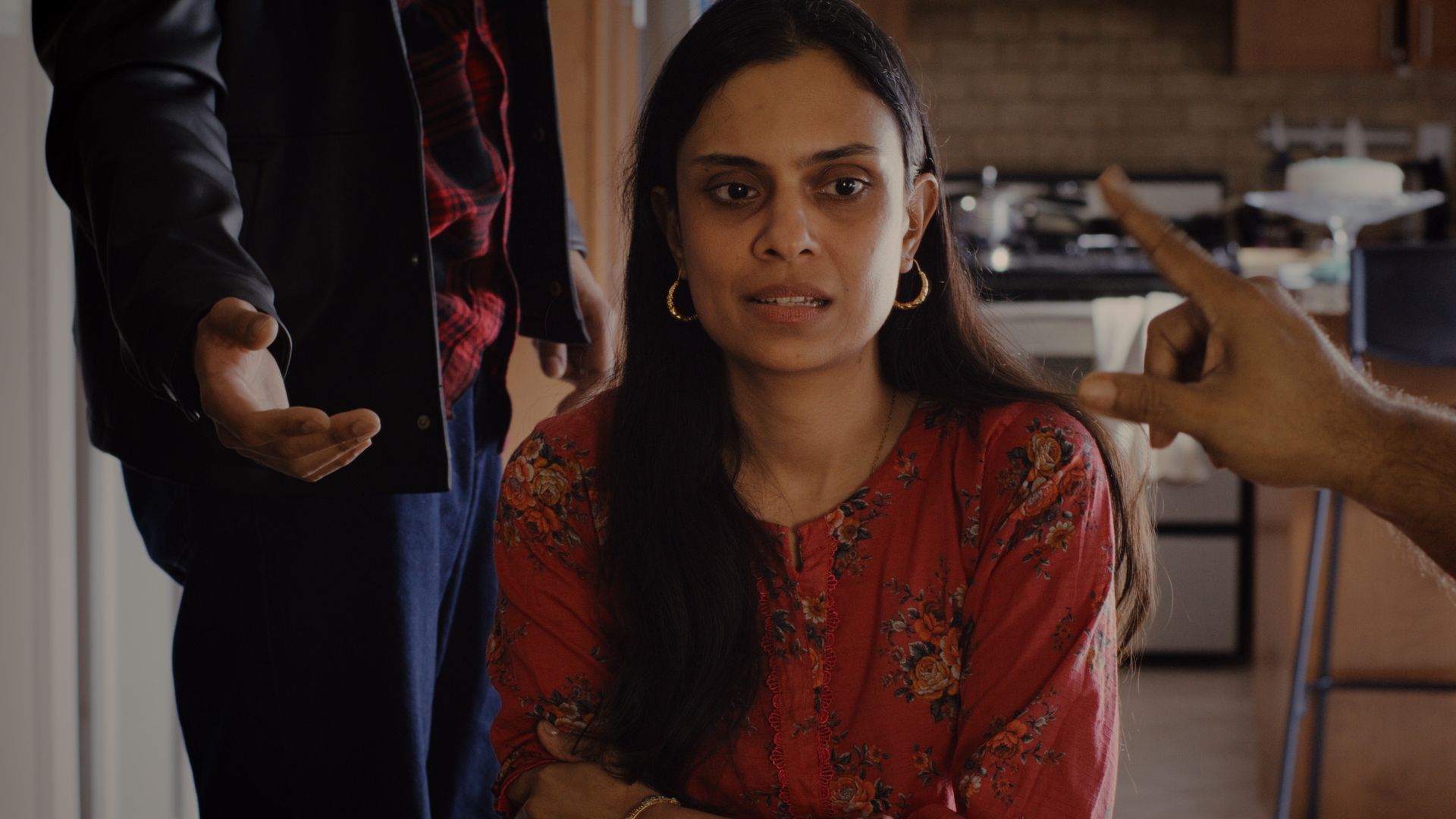
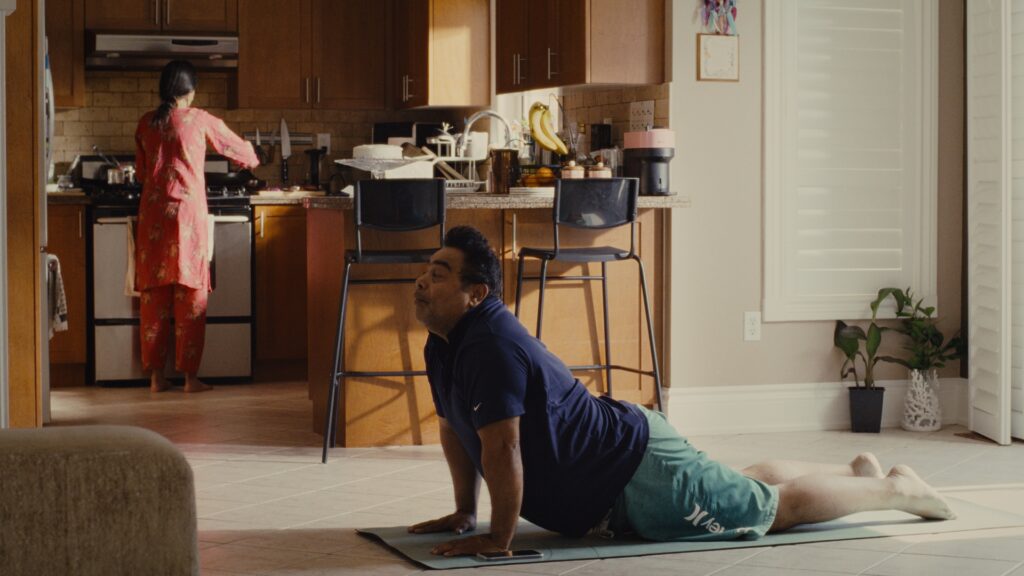
Pictured: Still from ‘Dream Girl’.
The protagonist has spent so much of her life fulfilling the roles of wife and mother that her own desires seem to have taken a back seat. How did you approach portraying the emotional labour and sacrifices that women are often expected to make within the household, particularly in South Asian families?
Nidhil Vohra: For me, it was very important that the relationship between sacrifices and labour is dealt with tenderly in the film. I wanted to amplify Kiran, the mother’s, desires because I feel that a hyper-focus on our mothers’ labour results in a form of normalization where we accept their sacrifices as a necessary by-product of their love. We understand deeply the pain of the sacrifice that they perform, but we are seldom made familiar with the weight of things that they have sacrificed. For instance, we know that the chores they perform are taxing, but we don’t know what they’re giving up in order to do that. Or what they would rather be doing, and how that would impact our lives. The Bollywood star, Prem, therein, stands as an allegory of this sacrifice. In a way, he represents the road not taken, and the life that could have been. Through this story, the idea was to emphasize that our mothers can achieve a lot more if they are provided with the right support systems and environments to do so. Through her interaction with Prem, Kiran is confronted with the reality of the life she leads and is reminded of the life that she had dreamt for herself as a little girl.
Visually, we tried to delicately mask the labour with a veil of comedy where the surface tells a story, but there is another story happening in the background that is more serious. In doing so, the idea was to mimic the relationship our families share with labour, where the cultural normalization and routinization of the mother’s domestic duties lead to us not even recognizing how much work she does in the background while we’re resting and relaxing. I think we do not even begin to understand the hours our mothers take away from their own personal lives to ensure we’re able to live ours comfortably. The idea was to confront the viewer with this exchange. To laugh at the surface but also look further to think of their own mothers.
Bollywood Fantasy and Emotional Vulnerability
Bollywood romance has long shaped popular ideas of love, desirability, and the ideal partner. In ‘Dream Girl’, you use that familiar cinematic fantasy to explore something much more intimate: a woman’s need to feel valued. What drew you to Bollywood as the framework for this story, and how did you balance affectionate nostalgia with a critique of romantic idealization?
Nidhil Vohra: I grew up on Hindi films and am biased towards that emotional, offbeat, over-the-top mode of storytelling that qualifies the mainstream output of that industry. The idea to find Prem in that 90s era of melodramatic young love was borne out of my mother’s love for Salman Khan and my own admiration for Aditya Chopra and Shah Rukh Khan. Across all their films from that era (‘Maine Pyaar Kiya’, ‘Dilwale Dulhania Le Jayenge’, ‘Kuch Kuch Hota Hai’, etc.), love is the grounding force. It is almost offered to the viewer as the key to eternal happiness. The idea of love depicted in these films is the idea of love that my parents grew up on, the idea of love that defined their youth and solidified all through their adulthood. I hold some apprehensions about it, though. To have that character of Prem and the appreciation Kiran has for him was to exemplify my qualms with that grand expression of surface-level romance that exists in these films. Why should Simran run away with Raj – she barely knows him. Why should Anjali give up her life for the same Rahul who friendzoned her in college? There is a visible sheen of patriarchy over these stories of young love that have reinforced generations’ ideas of culture, society, and tradition. So, to ground the film in Bollywood ideals was built out of these questions I had for the filmmakers and thinkers of that era. I was keen on questioning patriarchy using a mechanism that people from that era could relate to. I was also interested in paying homage to a cinematic language I idealize. I think the cast and crew came together well to realize this concoction. Especially the opening scene and the ending scene, with their individual splashes of colour, melodrama, music, and two very distinct ideas of love.
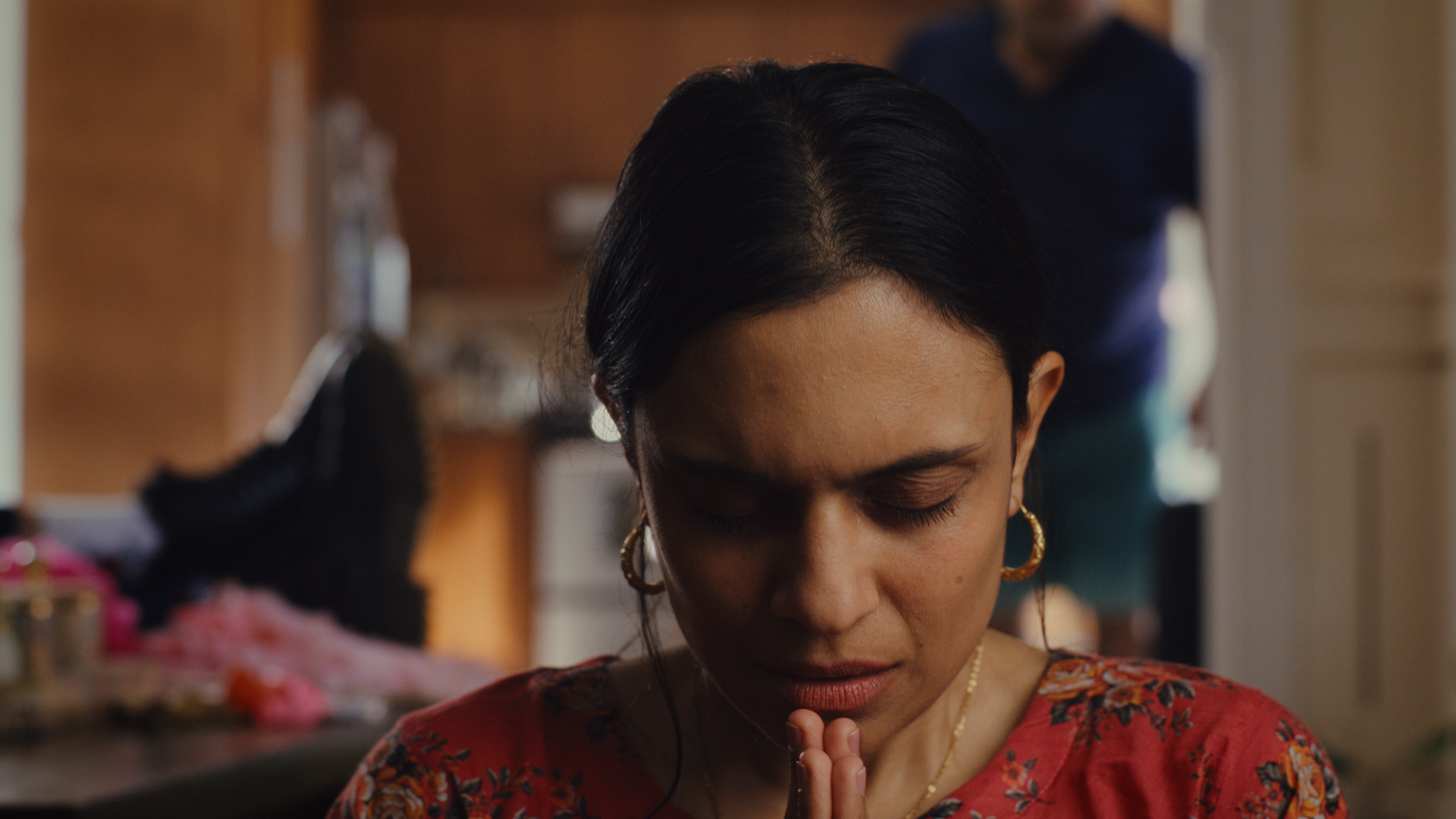
Pictured: Still from ‘Dream Girl’.
When her Bollywood dream man arrives and professes his love for her, we see just how deeply she responds to being desired and appreciated. How did you approach that shift in her performance, from disbelief and excitement to the emotional vulnerability of someone experiencing a kind of affection she may have been missing for years?
Zehra Nawab: As an actor, my journey started with theater. A big part of theatre training is controlling facial muscles, knowing how to use them to convey a certain emotion, and going through rigorous exercises that allow an actor to be present and in harmony with oneself. So during the shoot for ‘Dream Girl ‘, my theatre background equipped me with the skill set and the confidence to be able to effectively hit all the emotional beats within a ten-minute storytelling window. Director Nidhil and DOP Asmi Chandola’s frames allowed the actors to emote through their body language as well as through their expressions. Good scene partners bring out solid performances in one another, and in the scene that you are specifically referring to, credit goes to actors Simran Ghotra and Moazzam Khan, who were such a delight to perform alongside. We understood the emotional arcs required not only of us but also of our co-actors, which is what made performing this shift in emotions and vulnerability possible.
The premise is inherently funny and fantastical, but there’s also something quite heartbreaking about a woman being so overwhelmed by the prospect of being loved. How did you navigate the balance between the film’s comedy and the deeper emotional realities of your character without losing sight of either?
Zehra Nawab: The energy on the set of the short film ‘Dream Girl’ was extremely nurturing, communicative, respectful, and honest, which is what made it very easy to be wholly present in the emotions required by a scene. Having a rehearsal helped immensely, as we were able to have detailed conversations about how to surrender to the fantastical while remaining rooted in reality, how to bring to screen the humour while remaining connected to the pain, and how to ensure all aspects of the character are performed with authenticity while playing all spectrums of emotion with the same level of honesty. Even in between takes, if I was struggling, I would ask the team what the motivation of the character is in this moment or what headspace the dialogue requires right now.
When the Fantasy Shatters
One of the film’s most revealing moments is when the dream man addresses her by the name of the actress he is in the film with, exposing the gap between being loved as an individual and being loved as an idealized fantasy. What did you want that moment to reveal about the protagonist’s longing to be seen and understood?
Nidhil Vohra: In line with what you’ve identified, that moment is supposed to shatter the idea of the knight in shining armour. It was my way of speaking to my mother to let her know that as high as she thinks of Salman Khan and as loud as she cheers during his films – he is not coming to save her. It also plays off of that idea that regardless of how much strength and inspiration we may derive from our chosen role models or celebrity crushes, we may never find out what (if anything) we mean to them. For Kiran, decades of adoring this leather jacket-clad supernova of a man combust with him calling her the wrong name. In that moment she realizes perhaps that her desire of wanting to be seen, to be loved as she has loved this man or her husband or kids, may never be actualized. It is a reckoning of sorts that if she is able to love these men unconditionally as she has done for decades, it is time she does the same for herself.
The moment she realizes that the man may be in love with the image of a Bollywood heroine (or the idealized version of love presented in Bollywood) rather than with her as an individual is a turning point. What was your approach to playing that realization? How do you convey the disappointment of having a fantasy shattered while also allowing the character to begin seeing herself differently?
Zehra Nawab: As an actor, my job is to arrive prepared with the script learnt, the intention and motivation of delivering each line ascertained, and knowing the emotional arc of the character intimately. The beautiful part of filmmaking is that it is a collaborative medium between so many creatives; thus, when an actor arrives on set, their acting decisions are complemented by Mihir, Toral & Shreya’s set design, Subho’s light setup, Asmi & Roger’s framing, Anvi’s running of the set, and Nidhil’s direction.
Ultimately, when the lights are on, sound is rolling, and the director calls action, as an actor my job then is to be completely present, to surrender with earnestness to this particular moment in the story, with an openness to receive the emotions being given to me by my co-actors Simran & Moazzam, and trust preparation & instinct to react & emote as the character as she experiences the shattering of a fantasy. I am excited to watch this scene at the ‘Dream Girl’ premiere at Reel Asian Film Festival and see how it lands with audiences.
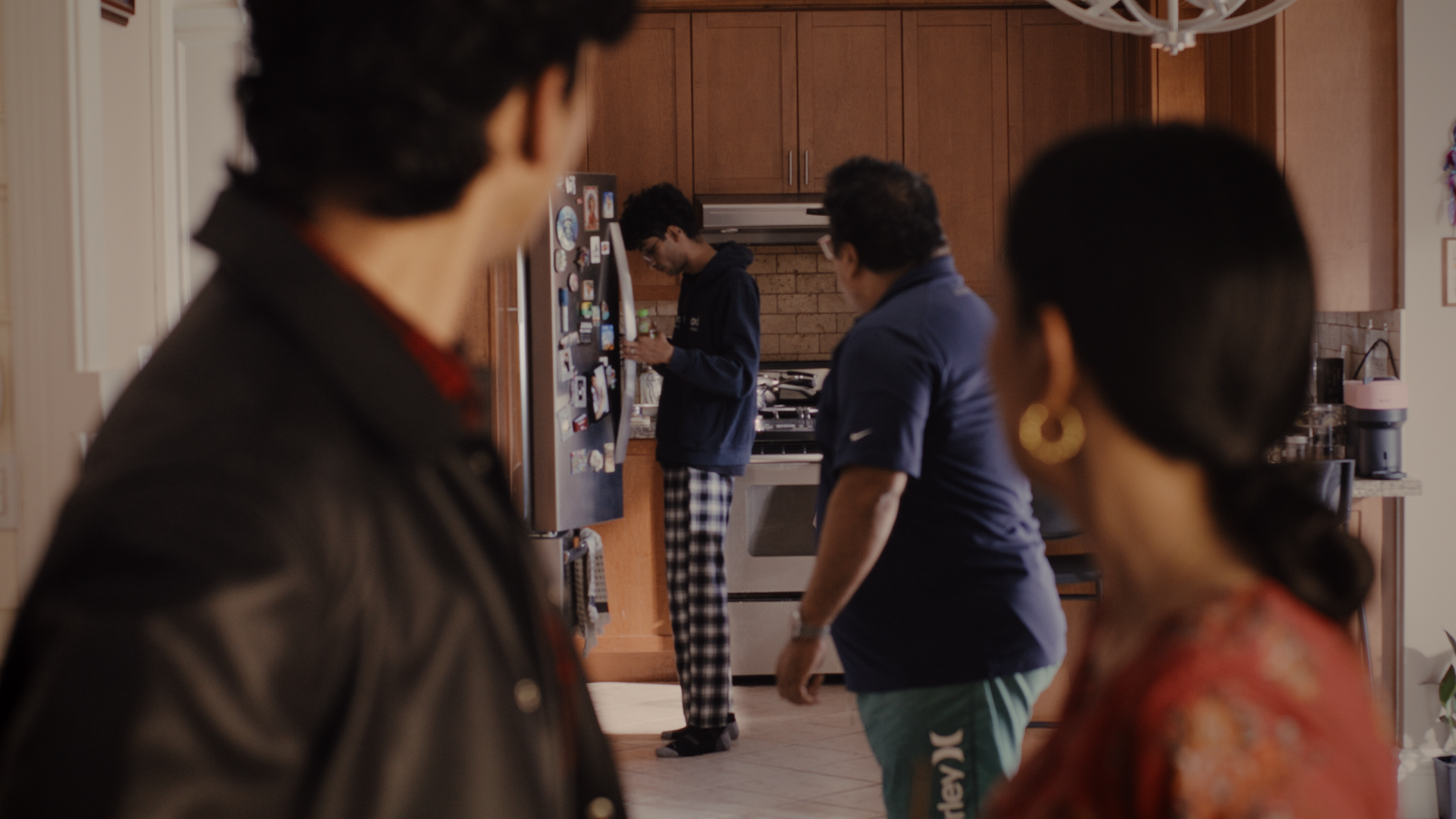
Pictured: Still from ‘Dream Girl’.
Becoming Your Own Dream Girl
By the end of the film, the idea of the ‘dream girl’ shifts. Rather than finding fulfilment through the man she has idolized, the protagonist begins to recognize her own worth. Was it always your intention for the title to take on this more personal meaning, and what does being your own dream girl mean to you?
Nidhil Vohra: I came up with the title as a placeholder when pitching the project to Reel Asian, and it sort of stuck along the way as the story took shape around it. I’d wanted to make a tongue-in-cheek reference to the fake Shantipriya-starrer ‘Dreamy Girl’ from Farah Khan’s ‘Om Shanti Om’ but dropped that idea as Dream Girl fit better for the reasons you’ve mentioned. Kiran is the eponymous Dream Girl, but she is also the girl who dreams, and it is also her dream that is shattered. For me, being your own dream girl is to never wake up. It is to continue building your ideal life, adding to your goals, dreaming up new dreams every single night, and never attaching your self-worth to something that exists outside of your dreams or something that society would want you to do.
By the end of the film, Kiran’s journey isn’t about choosing between her husband and her Bollywood dream man, but recognizing that her worth doesn’t depend on either of them. What did you want this final emotional shift to reveal about her relationship with herself, and what do you hope South Asian women, particularly middle-aged women who may see parts of their own lives reflected in Kiran, take away from ‘Dream Girl’?
Zehra Nawab: I hope each audience member, regardless of gender and age, takes home this message that we need to be our own story’s hero and our own biggest fan. This is what stayed with me well after the cameras stopped rolling. And I think this is what stays with the character that I play in ‘Dream Girl’. I truly hope this is what audiences take away from our film… buckets full of self-love. A message that would resonate with all age groups, ethnicities, and genders.
Bringing ‘Dream Girl’ to the Screen
As a writer, filmmaker, and film critic whose work explores identity, class, religion, and belonging, you’ve chosen to tell this story through comedy and fantasy. How did the ‘Unsung Voices’ workshop shape the film, from developing the initial idea to bringing it to the screen? And what has having ‘Dream Girl’ premiere through this programme meant to you as an emerging filmmaker?
Nidhil Vohra: I am forever indebted to the Reel Asian Film Festival and the ‘Unsung Voices’ program. For the past few years, owing to my formal education, I’ve learnt to study films, film movements, auteurs, cinematic languages, and break down every single component, process, and idea that becomes the act of filmmaking. But since I was a kid, I’ve wanted to learn how to make films and how to make them well. The ‘Unsung Voices’ program allowed me to do just that. It made me a director. It allowed me to tell a story I wanted to tell. The wonderful speakers who delivered workshops every week went deep into the practical aspects of filmmaking, which taught me things I had never had the opportunity to learn. We received exceptional support as ‘Unsung Voices’ participants. I think in a month of pre-production I must have offered around five to six drafts of the script to the team for their thoughts and feedback. In the editing period as well, they coached me through a series of cuts in a truly laborious process. I don’t think this film would have looked or felt like it did if it weren’t a part of the ‘Unsung Voices’ program. There is a lot that I’ve learnt through this process and reflecting upon it that will continue to influence my work.
Most importantly, the wonderful troika of Tricia, Amreen, and Joseph, who were the coordinators of the program for my year, provided support, compassion, and understanding at every step, allowing those of us in the cohort to go out and bring these stories to life. To make ‘Dream Girl’ through ‘Unsung Voices’ and have it premiere as part of the Reel Asian Film Festival is truly special for me for these reasons. I’ve watched many films at the festival and at the TIFF Lightbox over the years, and to see ‘Dream Girl’ there is definitely a moment I will cherish forever.